


Alan Thornett, who has died aged 89, was the best-known militant in the British car industry during the decade when that industry settled the fate of British trade unionism. He spent the next forty years explaining, with names and dates, why that fight was lost and why it need not have been. His last article appeared in September 2026. He died in Oxford on 9 October 2026.
Alan was born on 15 June 1937, near Oxford. He worked on the land from about fifteen and served three years in the army. In the summer of 1959 he started at the Morris Motors plant in Cowley, feeding the track for the new Mini. That year he joined the Communist Party; he left it in 1964. A shop steward from 1963, in 1967 he became the TGWU’s deputy convenor in the plant and chair of its Joint Shop Stewards Committee.
Our movement talks a great deal about working-class leadership and produces it rarely. Everything he knew about Marxism and the economics of the car industry he taught himself, and decades later he did the same with the Earth sciences. The habit that made him a good steward, having the facts and the figures before the meeting started, was the habit that made him a good writer.
Cowley
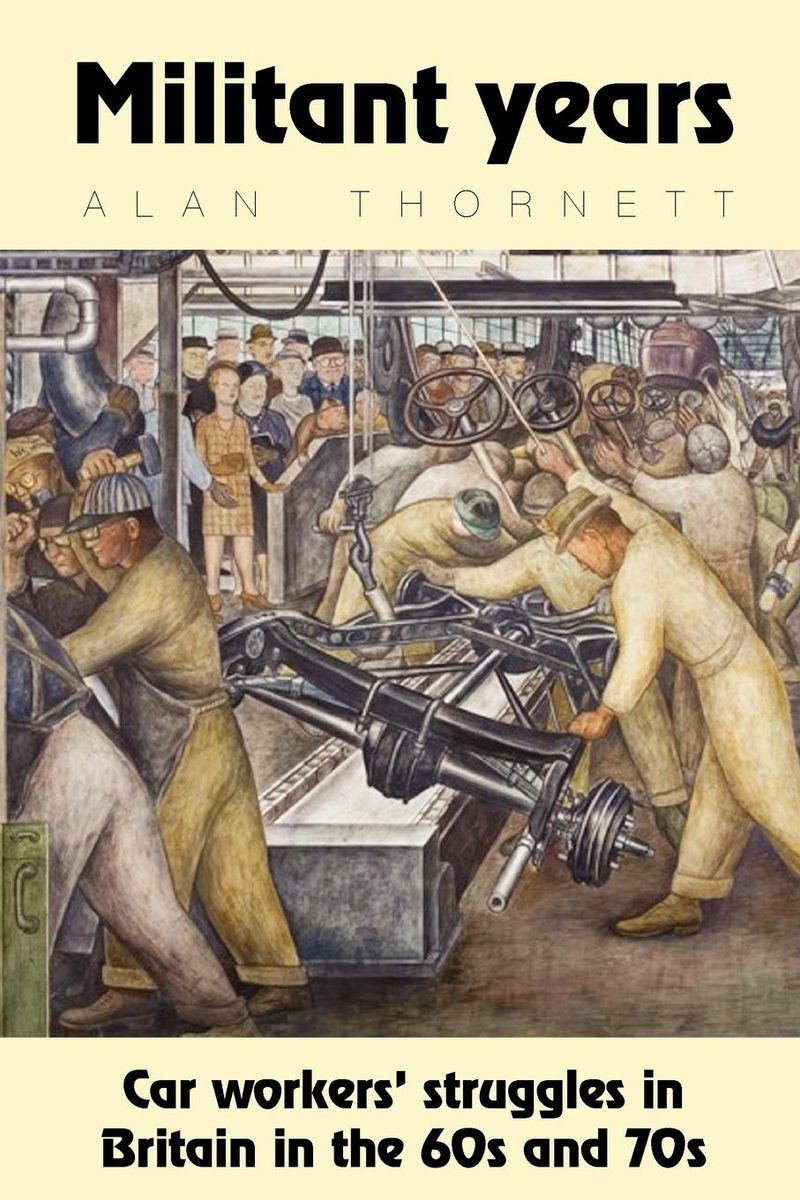
Cowley was one of the most militant plants in Britain. By the end of the 1960s it averaged more than three hundred stoppages a year, and it struck against both Harold Wilson’s In Place of Strife and Edward Heath’s Industrial Relations Act. In Militant Years (2010) Alan is clear that the workers on the line built that movement themselves. He is just as clear that the full-time officials of his own union worked with management, for most of the decade, to break the stewards’ organisation.
What the stewards built was, in Alan’s description, a form of workers’ control inside the plant. In the winter of 1971 management tried to bring in work study, with engineers timing every job. Whenever the engineers appeared, the line stopped. Within days the company conceded that no job could be timed or changed without the stewards’ agreement. It was called mutuality: the pace of work was negotiated with the people doing it. In January 1972 the same committee blocked the movement of coal inside the plant in support of the miners.
I was once told that Cowley pickets in a long hot summer claimed the cost of their sun cream. It may be a myth. The point is not: before Thatcher, workers’ self-organisation was sometimes strong enough that a claim like that sounded winnable.
For ten years Alan was a member of Gerry Healy’s Socialist Labour League and its successor, the Workers Revolutionary Party, and it was there that he first faced the apocalypse. Healy’s party had predicted an imminent military coup and organised to prepare for it. In 1974 Alan wrote an opposition document that said plainly, “I think this prediction was wrong.” Against what a second document called the party’s “ultimatistic and catastrophic approach to the organised working class”, he argued for the method of the Transitional Programme: put demands on the left Labour MPs, so that their refusal to fight the Wilson government would be exposed to those who voted for them. On 24 November 1974 Healy challenged him at an aggregate meeting; the next morning a Control Commission expelled him. About two hundred members followed him out. The expelled comrades founded the Workers Socialist League in October 1975, with Socialist Press as its paper.
The next years were a war of attrition. In the plant’s union elections of January 1976, seven national dailies and three television networks campaigned against him, and British Leyland refused, year after year, to recognise him as deputy convenor. He was finally sacked on 17 November 1982, nominally over a lapsed heavy goods licence, in fact to clear the plant before a new model went into production.
Much of what he wrote in those years did not carry his name. He wrote as Bill Peters in Socialist Press and Socialist Organiser, sometimes reporting his own victimisation in the third person. In 1983 he visited Toyota’s Takaoka plant and wrote a five-part series setting it beside Cowley. Lifetime employment and the company union, he showed, rested on the smashing of independent unions after the war. The Japanese model was not a stage of technology. It was a defeat that had been exported.
He spent the miners’ strike without a workplace, writing in Socialist Viewpoint. His argument, held for the rest of his life, was that the government could not have taken on another major union at the same time as the NUM, and that the union leaders declined every route to a second front. He spent the next decade arguing against the story that the strike had been wrong to fight. Inside Cowley (1998), with a foreword by Ken Loach, showed how enforcing the Social Contract under the Labour government of 1974–79 had softened up workplace trade unionism for the offensive of the 1980s.
In 1987 Socialist Viewpoint merged with International to form Socialist Outlook, and from then on Alan was a leader of the British section of the Fourth International and an elected member of its International Committee. His reports of its congresses were often the only account British readers got. When Healy died in 1990 Alan wrote the obituary, allowing himself one line of irony: Healy had done more to discredit Trotskyism than anyone else, “despite other strong contenders for that distinction”.
I worked with Alan day to day in the 1990s on the staff of Socialist Outlook, when the collapse of the USSR and the victory of neoliberalism were testing every organisation on the left. Alan rose to it. When war came to Bosnia he threw himself into International Workers Aid, founded in 1993 to take the labour movement’s solidarity to the multi-ethnic resistance, and he drove lorries to Tuzla himself, more than once.
Broad parties
He was building broad parties long before the phrase was fashionable, and he never pretended it was easy. He worked in the Socialist Alliance, Respect and Left Unity. He was a founder of Socialist Resistance and then of Anticapitalist Resistance. His reasoning was always rooted in class: a party to the left of Labour was part of regenerating the unions, not a substitute for it.
Alan wrote as he talked, plainly. The facts came in date order with the ballot figures attached. Above all he was fair to the facts, even when the left’s reflex ran the other way. After the defeat at Grangemouth in 2013, when much of the far left was denouncing Len McCluskey, he set out the evidence that the stewards had recommended acceptance and the workforce had voted for it. He saw at once that David Cameron’s Brexit referendum was likely to become a carnival of reaction, and he persuaded many on the left that this was not the occasion to leave the EU.
Ecosocialism
The second apocalypse was real. Ecology became the main subject of his last twenty years, and he got there earlier than most of the British far left. In a 2020 preface to the Chinese translation of Militant Years he named the one part of the Cowley record he would not defend. The stewards had the strength to make people take the ecological crisis seriously, and like the rest of the union movement they never used it. There is no improving workers’ conditions on a dying planet, he wrote, and no building a socialist future on one.
He read the Earth-system scientists and explained them for socialists. Facing the Apocalypse: Arguments for Ecosocialism (2019) started from the left’s “bleak” record on the environment. Ian Parker called him the David Attenborough of the revolutionary left.
He wrote on the climate until weeks before his death, and he treated it as a class question. Who would pay for the transition, and who would have to be made to concede it? His most repeated line was that “nothing can be built on a dead planet”. Yet he never let the catastrophe become an ultimatum. The point he pressed hardest was the one he had made against Healy in 1974: a movement that cannot force change under capitalism cannot overthrow it.
In 1987, speaking of the Argentinian Trotskyist Nahuel Moreno to a room of currents that had spent decades expelling one another, Alan said: “He did not have the whole answer and none of us have the whole answer.” He would not want more claimed for himself than that. What he had was the habit of writing it down in the week it happened, with the names in. Some 371 of his pieces, from 1976 to 2026, are collected at thornett.redmole.org. His papers are at the Modern Records Centre, University of Warwick.
Alan Thornett, trade unionist and socialist, born 15 June 1937; died 9 October 2026.
A longer version of this obituary, with links to Alan’s writing in the Red Mole archives, is at redmole.org: https://redmole.org/p/alan-thornett-19372026
Very sad news. A legend. I joined Socialist Outlook largely because of Alan’s leadership and record. He was more recently a signpost for ecosocialism, way before it took off among the left.