


Sin, punishment, guilt, repentance and forgiveness are at the heart of the Catholic faith as any one brought up in it will tell you. The ritual of confession where the faithful go regularly to tell a priest of their sins and receive penance and absolution is significant feature of Catholicism
Jimmy McGovern comes from a Liverpool Roman Catholic background and his writing, like Graham Greene’s, reflects that religious background. In all three of his brilliant series on British prison life we see the main characters wrestle with their consciences about whether to tell the truth, even if that will cost them dearly in terms of physical well being, career or personal relationships. This applies both to the prisoners and the prison officers. The trilogy has been a triumph precisely because the hard hitting exposure of the utter failure of the British prison system is embedded in a web of authentic human stories that engage us from the start of the first episode.
After tackling the reality of adult male prisons and then women’s ones, this time McGovern is taking the lid off young offenders Institutions.
Banged up alone for most of day
From the start, the writer ensures that you hear the scale and the pain of the young people shouting out, screaming or howling their anger and anxiety. I did not expect that. It appears to hardly stop. Part of the reason for this hellish environment must be the fact the offenders are locked up in single cells for such long periods of time.
According to the programme this is partly due to a ‘keep apart’ system which means that boys from different postcodes are not allowed to mix for fear of fights. The other reason they are ‘banged up’ for such long periods is staff absence and lack of funding. In one scene the lack of staff means a boy cannot attend the funeral of a family member. The boys are easier to control if they are all kept separately in cells most of the time.
We observe a gymnasium and some basic recreational facilities like pool or table tennis but little opportunity for serious learning or skills training. Most of the time the young people are kept inside with little natural light or contact with the natural world. It is up to the ex-nun chaplain– a huge performance by Siobhan Finneran- to try and individually help an inmate to learn to read and write. Most of the offenders have totally been failed by the school system and are pretty much illiterate.
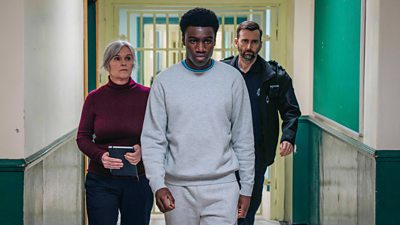
When a black boy is the victim of a terrible racist attack, we observe how the institution tries to cover up the incident. One prison officer, Bobby Bailey – the lead character played by David Tennant – suggested that the reconciliation meeting between the two boys was extremely risky and he recommended it did not take place. After the ferocious attack the other prison officer convinces Bailey to not reveal this.
How problems covered up
The violent assault is the plot line that runs through right to the final scenes as we wait to find out if this secret is held or not. Initially Bobby wants to tell the truth, particularly after the other officer pulls a sickie to play golf which results in a boy not getting to his family funeral. When he confronts the other officer he is headbutted which pushes him to talk to the governor.
Here there is a memorable scene where the governor explains how damaging it would be to the institution if it all came out and that Bobby would find it hard to work with his fellow officers who would treat him as a grass. The institution could even get closed down and jobs would go. Then comes the clincher when the governor mentions the assistant governor job is coming up and he thought Bobby would be great for it. So the situation is temporarily resolved and Bobby gets a pay rise and a new job.
This shows how – a bit like the police – there is a code of behaviour among prison officers that prevents full transparency and covers up these sorts of incidents. It almost a mirror image of the code that exists amongst the prisoners. At one point Bobby explains to his new partner how closed the world of the prison officer is – it works like an alternative family. Certainly the stress of dealing with the violence and traumatised inmates for not a great deal of pay must take a psychological toll on the people keeping some sort of order.
A code that prevents the truth
A similar plot line about whether to tell the truth or keep a secret is played out among a group of boys who as a group had killed a man. The boy who actually went back to call an ambulance and had not been directly involved ends up with blood on his clothes so he risks being convicted. If he tells the truth his cousin, whose family had looked after him, will get a long sentence. Like Bobby’s secret this keeps the tension going through the three episodes.
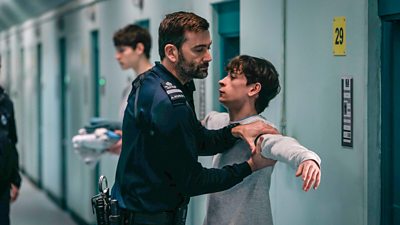
Marie, the chaplain, played by Siobhan Finneran who was so great in Happy Valley, is the other main character and she tries hard to make some small changes in the institution. She had left the convent because she had fallen in love with a priest and now questions her faith. So McGovern throws in another engaging plot line as you follow her more humane approach and wonder whether she will reconcile with the priest who has obeyed the church and broken off with her.
Just like the other two series in the trilogy, McGovern’s superb story telling and creation of such conflicted characters means that his overall exposure of the failure of such youth offender institutions has perhaps more impact than if he had made a straightforward documentary. Many millions more will follow a well told story than a factual one.
Official reports highlight the issue
A report by the Chief Inspector for Prisons, Charlie Taylor in 2025 found that “most of their time the offenders were locked alone in their cells” The report laid bare the “failure” by the Youth Custody Service to “create environments in which staff and children are able to form positive, appropriate relationships”.
Campbell Robb, chief executive at social justice charity Nacro, said the report was “more evidence that the environment in our YOIs is profoundly harmful for children, many of whom are already extremely vulnerable”. (ibid BBC)
It is not as though we are dealing with that many young people – there are only around 500 youth (nearly all male) who are locked up in secure jails. A Labour government that really wanted to change outcomes for working class young people would adopt a quite different approach, investing in real educational and psychological support and developing smaller more human secure units.
Just as with adult prisoners a failure to provide a system of positive rehabilitation just means there are more social costs further down the line. Young people who are brutalised inside these institutions are more likely to carry out violent acts as they get older.
Trailer : https://www.bbc.co.uk/mediacentre/2026/time-series-three-trailer