

This is the first statement from the 17 October Movement, as it appeared on Instagram and Telegram during the night between Sunday 18 and Monday 19 October. It was reproduced in an article by Roberto Maggioni in Il Manifesto of Weds 21 October.
Statement from 17 October Movement
“Nobody represents us. We represent ourselves. We don’t have a president, a secretary, a spokesperson to invite onto TV, an office to search or a membership card to sell. We are young people who have decided to stop waiting. Our name is a date, not an organisational chart, because a date belongs to everyone and no one can claim it as their own. We are not an acronym. We are a process: an unstructured movement born to take the initiative and advance the collective political consciousness of young people in Italy.
Institutional parties and trade unions are part of the state we oppose, and we treat them accordingly. As for the non-institutional ones – starting with the activist groups that for decades have sought to profit from and monopolise the struggles – we do not consider them up to the task. This is not a renunciation: it is a condition. They must prove themselves, in practice, by placing themselves at the service of the struggles rather than putting the struggles at the service of their own survival, their own organisations, their own calls to action and their own careers.
Until then, no one speaks on our behalf and no one lays claim to our public spaces.’ In writing this, however, someone is already speaking on behalf of others. ‘A movement with a leader has a target. A movement with a direction has a breakthrough. A movement with a membership list has a dossier. We offer no targets.
[ Our referencecs are:] Egypt in 2011, where a leaderless square brought a thirty-year-old regime to its knees; Tunisia, where it all began; Hong Kong in 2019 and its “be water” approach – organising in a decentralised, adaptive, elusive way; Sudan, with its neighbourhood resistance committees; Algeria and Lebanon, where the streets refused to be represented by the old power structures; Chile in 2019’.
What do we want from the streets?’
It is not enough for the streets to be merely about protest. Protest alone burns itself out.
We want every moment in the streets to also be one of discussion, debate and political growth. We want a lively, spontaneous and strong dialectic to emerge from the grassroots, between different people who listen to one another, clash over ideas and transform one another. We do not seek unanimity; we seek collective maturation. We want the streets to be schools of politics, and for young people to emerge from them more aware than when they entered.”
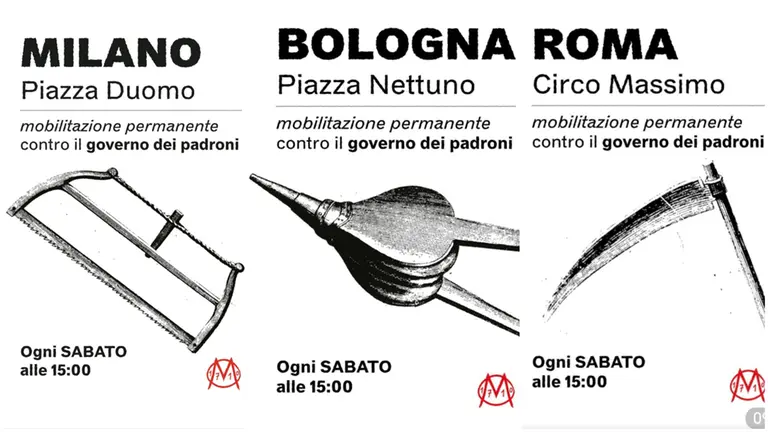
[ the social media page is calling for] ‘a permanent mobilisation every Saturday at 3 pm until the government falls.
Cause for reflection
There is a obvious contradiction between saying that nobody represents the movement and writing a statement that is entitled 17 October Movement. However the statement probably reflects some of the sentiments of some of the young people involved. It is positive that there is an attempt to give a political interpretation of what is happening and that this comes from the heart of the movement.
It is strongly internationalist but makes links with countries outside Europe rather than linking with movements in France or the Spanish state. Palestine solidarity has been strongly supported among young people and the Palestine flag has been visible in these mobilisations.
This is a movement organised on social media, on Instagram and Telegram. So far there have not been any organized physical meetings. We should not overestimate how influential or representative it is.
Interviews in the media show there are other views ranging from a focus on demands for their education to vaguer concerns about ‘no future’ and AI. Young people smashing shop windows and looting may have less direct political motivation. They have talked of their lack of funds faced with luxury items or simply the fact they cannot afford the trainers the adverts push them to covet.
Confronting the police is also a way for those kids in the poorer suburbs to have a day when they are kicking back against the police. They suffer endless dentity stops when they come into the smart areas of town.
Nevertheless people on the left – particularly when observing from afar – should not romanticize the youth’s violent actions as though it is the first stage in a revolutionary insurrection.
The parties and trade unions are placed in the same ‘institutional’ category as the state which suggests some anarchist influence that socialists or anticapitalists would not share. We do not think political parties are the same as the police. Groups or currents who are to the left of the ‘institutional parties’ are also criticized.
To an extent this is also the result of the failures of the left. It has been unable to provide a relevant political alternative on the back of decades of defeats. However this statement represents a will for self organization and a refusal to be co-opted by political professionals.
The danger is that the need for structures and democratic representation going forward is rejected. Structurelessness is not necessarily more democratic.
Furthermore to win the youth have to forge a political alliance with workers, trade unions and left parties. Discussion will be needed on what demands to make and how to confront the government.
Needless to say the mainstream media and government are reproducing all the information about this social media sponsored movement in blood curdling and exaggerated detail.
On the other hand the left needs to engage with such emerging currents.