

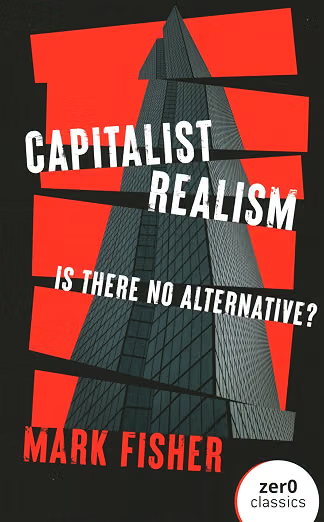
When Mark Fisher published Capitalist Realism: Is There No Alternative? in 2009, the neoliberal order was already damaged. Lehman Brothers had collapsed. Banks had been rescued by states which had spent the previous thirty years insisting that markets possessed a wisdom governments could never match. Yet the financial crash did not produce the ideological break many on the left expected. The banks failed and capitalist realism survived them. Within a few years the cost of rescuing the financial system had been translated into a crisis of public spending and austerity was presented as realism restored.
Fisher’s argument was never simply that capitalism had won an argument against socialism. Something more thorough had happened. Capitalism had acquired the status of the world itself, difficult to separate from ordinary ideas about practicality, adulthood and common sense. Markets were realistic. Privatisation was realistic. Wage restraint was realistic. Public services had to be realistic about what could be afforded. Workers had to be realistic about what employers would tolerate. Political choices arrived disguised as constraints.
This is why the book has lasted. Fisher was interested in what happens after an ideology stops looking ideological. He writes that what counts as realistic at any moment is “defined by a series of political determinations”. An ideological position becomes truly successful when it is no longer experienced as a value at all, but as a fact. Neoliberalism had installed what he called a “business ontology”, in which it appeared simply obvious that institutions from schools to hospitals should be organised according to the logic of business.
Nearly two decades later, the atmosphere feels different. Capital still dominates economic life, the business ontology has hardly disappeared and the disciplining powers of rent, debt and wages remain painfully concrete. What has weakened is the confidence with which the system explains itself. There is still no permitted alternative, but increasingly there is no convincing account of what the existing order is for, where it is going or why its contradictions should be endured.
Technofascist irrealism?
Mike Watson’s recent essay “Technofascist Irrealism” attempts to name this altered condition. His argument starts from Fisher but moves towards a politics in which reality itself appears unstable, endlessly reconstituted through platforms, images, conspiracies, artificial intelligence and political spectacle. Watson writes that we have moved beyond Thatcher’s insistence that there is no alternative towards a condition in which there is “no inferred realism, no semblance of reality to speak of”.
I am not wholly convinced by “technofascism”. The phrase gives technology too much explanatory weight. Silicon Valley matters enormously, but technology does not descend upon society from elsewhere. Someone owns the infrastructure. Somebody supplies the capital and expects a return. Platforms have business models. Data centres sit on land, consume energy and require labour. The cloud has landlords. Even the most apparently immaterial parts of contemporary capitalism remain property relations with wires attached.
Yet Watson’s “irrealism” catches something that “post-truth” never quite managed. The issue is not simply that politicians lie or that people believe things which are false. Politics has always contained lies. Nor has material reality disappeared. A worker either gets paid or does not. A rent rise arrives whether one believes in it or not. Bombs destroy buildings. Carbon continues accumulating in the atmosphere while arguments about climate change circulate online. Reality remains obstinate.
What has become unstable is the relationship between material reality and its political representation, though rereading Fisher makes it difficult to say that this begins after capitalist realism. The instability was already inside it.
In one of the most useful passages in the book, Fisher complicates the ordinary meaning of realism itself. “‘Being realistic’ may once have meant coming to terms with of a reality experienced as solid and immovable,” he writes. “Capitalist realism, however, entails subordinating oneself to a reality that is infinitely plastic, capable of reconfiguring itself at any moment.” The worker is required to adapt continuously while the organisation restructures around them. Yesterday’s certainty disappears, management changes its objectives and everyone is expected to behave as though the new arrangement had always been inevitable.
Plasticity of capitalism
Elsewhere Fisher compares capitalism to the creature in John Carpenter’s The Thing, “a monstrous, infinitely plastic entity, capable of metabolizing and absorbing anything with which it comes into contact”. This is quite different from the caricature of capitalist realism as a world of fixed certainties. Capitalism’s realism already contained unreality. Its great ideological achievement was to make permanent instability appear natural while presenting any attempt to impose democratic control over that instability as unrealistic.
There is a recognisable line from that condition to the politics Watson describes. The ground moves constantly, but the requirement to adapt remains. The financial crisis changes the rules, then austerity changes them again. Globalisation is irreversible until tariffs become desirable. Free movement of capital is sacred while borders for people harden. The state must retreat from economic life and simultaneously expand its surveillance and coercive capacities. None of this requires the system to admit that yesterday’s necessity has become today’s mistake. Reality is updated.
Fisher saw something similar in the institutions around him. Neoliberalism had promised to sweep away the suffocating bureaucracy associated with the old state sector. Instead, bureaucracy multiplied. Targets, assessments, monitoring, audits and performance indicators spread through education and public services. The rhetoric was entrepreneurial freedom; the daily experience was form filling.
Market ‘Stalinism’
His phrase for this was “market Stalinism”. The comparison was deliberately provocative but the point was precise. Institutions became increasingly concerned with constructing representations of successful performance. Fisher quotes an anthropological study of British local government which found that more effort could go into ensuring services were represented correctly than improving the services themselves. He concludes that late capitalism repeats from Stalinism the valuing of “symbols of achievement over actual achievement”
A government announces an initiative and the announcement becomes evidence of action. A politician visits a border and the image becomes border policy. A target is published and its existence demonstrates resolve. The same policy can be announced several times because the announcement is itself one of the products of government. Reform and Restore Britain can circulate figures about migration whose political utility bears little relation to their explanatory value, because the figure does its work at the point of circulation. It says crisis. It identifies an enemy. It produces recognition among people already primed to recognise it.
Social media did not invent this separation between representation and performance. It found a society already organised around it and made the cycle vastly faster.
Donald Trump is unusually well adapted to such conditions. He can speak the language of isolationism while projecting American power abroad, denounce elites while governing with billionaires, promise economic protection to workers while redistributing upwards, attack state bureaucracy while expanding the coercive arms of the state. The contradictions are obvious, endlessly catalogued and politically less damaging than liberals repeatedly expect them to be.
Watson calls Trump an “immovable signifier in a vacuum of sense”. It is a useful description because Trump need not resolve the contradictions. They occur in different moments and address different desires. The statement is consumed, produces its effect and disappears beneath the next one.
Traditional propaganda generally attempted to establish a durable account of the world. Contemporary platform politics can function with something much thinner. The claim needs to survive long enough to produce anger, affirmation, identification or fear. By the time somebody has found the original dataset, checked the denominator and demonstrated that the number being circulated does not mean what the politician says it means, another claim has arrived.
The lie has not ceased to matter. Its half-life has shortened.
Hyperpolitics
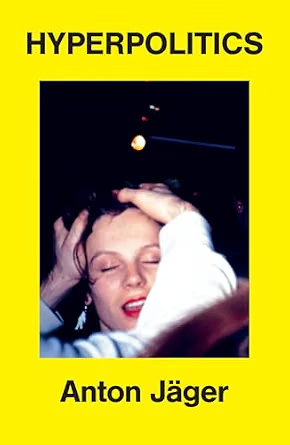
This is also where Anton Jäger’s account of hyperpolitics becomes useful. We appear to live in an extraordinarily politicised age. Politics is difficult to escape. People who have never joined a political organisation spend hours discussing migration, Gaza, Trump, gender, crime, race, taxation and national identity. A controversy can involve millions of people before breakfast and feel exhausted by Friday. Yet this intensity exists alongside the hollowing out of many of the organisations through which politics once acquired duration.
A trade union does not merely express an opinion about an employer. It potentially interrupts production. A tenants’ organisation can resist an eviction. A political party in the older sense attempted to retain members, educate them and connect immediate fights to some longer conception of political change. These institutions could be bureaucratic, exclusionary and deeply disappointing, but they accumulated memory and sometimes power.
The feed accumulates reaction.
Fisher’s concept of “reflexive impotence” helps explain why hyperpolitics and political powerlessness can coexist. Writing about students, he rejected the idea that they were simply apathetic. “They know things are bad,” Fisher wrote, “but more than that, they know they can’t do anything about it.” Crucially, he did not treat this knowledge as an innocent description of reality. It became, he said, “a self-fulfilling prophecy”.
That idea looks more, not less, relevant in a society saturated with political expression. Reflexive impotence no longer has to look passive. It can be furious. It can post twenty times a day, follow every political scandal and acquire an encyclopaedic knowledge of the enemy. The feeling of activity can coexist with very little capacity to alter the relationships producing the anger.
This complicates any easy opposition between Fisher’s supposedly passive neoliberal subject and the hyperpolitical subject who came later. The hyperpolitical subject may be the reflexively impotent subject with a smartphone.
Contradictions of far right policies
The right has been particularly effective at filling the space between impotence and action. It offers enemies that can be named and acts that can be imagined. Close the border. Deport them. Sack the civil servants. Leave the treaty. Arrest the protestors. Abolish the department. The appeal is not merely ideological. After years in which mainstream politics told people that the most consequential economic arrangements were beyond democratic control, the hard right restores the sensation that somebody can still make things happen.
The contradiction appears quickly enough. Rupert Lowe can present the British state as bloated, wasteful and oppressive while Restore Britain advocates mass deportation on a scale that would require an extraordinary enlargement of coercive state capacity. Its mass deportation proposals imply detention, surveillance, immigration enforcement, legal restructuring, transport, international agreements and a bureaucracy capable of identifying and processing enormous numbers of people.
The same politics can demand that the state shrink and that it reach more deeply into everyday life. There is no need to reconcile the two demands if they are consumed separately. One post denounces bureaucracy. Another demands deportation. A third attacks taxation. A fourth demands tougher policing. The contradiction exists mainly for somebody who stops scrolling long enough to assemble the programme as a whole.
This is what I mean when I keep returning to the thought that the tweet is the politics. Not because there is nothing behind the tweet. Restore’s policy papers are a warning against that complacency. Detailed projects involving citizenship, borders, courts and state power can sit behind apparently disposable online messages. The point is that the political communication no longer has to reproduce the coherence of the project underneath it. It needs to mobilise an audience around particular affects and enemies.
Governing elites become incoherent
Trump’s second administration makes the distinction still more important. Jäger’s recent “Hyperpolitics in Command?” asks what happens when the form of politics shaped in opposition reaches the executive and learns to use state machinery. He describes a wider scrambling of elite political culture, not merely a Trumpian personality defect. The significant part of the argument is that incoherence has spread upwards. Governing elites themselves struggle to construct durable strategies across competing fractions of capital, geopolitical interests and increasingly volatile electorates.
That seems closer to the world around us than the older image of a confident dominant class imposing a settled neoliberal project. There is still a dominant class, but its fractions do not necessarily agree about what the system requires. The interests of finance, fossil capital, technology firms, manufacturing, property and national security do not automatically coincide. Billionaire political actors can pursue private interests that cut across attempts to construct a stable collective project. Trump may therefore be less the architect of the chaos than one political form adequate to it.
Neoliberalism once possessed a story about the future. It promised modernisation, global integration, consumer abundance and steadily expanding prosperity. The story was never equally true for everyone, but it supplied direction. Globalisation was presented almost as a natural process. Governments might cushion its consequences or train workers to survive it, but reversing it was no more imaginable than reversing the weather.
The future attached to that story has deteriorated. Housing becomes less affordable. Public infrastructure decays. Climate breakdown becomes more visible while political ambition contracts. Growth is promised with increasingly little conviction. Artificial intelligence is presented as both economic salvation and mass redundancy. Governments promise security while producing lives organised around insecurity. People are told that technological change is unstoppable and then asked to trust political institutions which plainly have little idea what to do with it.
Fisher’s “business ontology” remains almost perfectly intact inside this confusion. Universities behave like businesses, hospitals acquire managerial targets, public institutions talk about customers and outputs, individuals are encouraged to treat themselves as portfolios of skills requiring constant improvement. The system has lost much of its progressive story without surrendering the institutional forms constructed during its confident years.

Decompositon of capitalist realism
Perhaps this is what it means to say capitalist realism has decomposed rather than ended. Its disciplines survive its optimism.
The decomposition also alters the way distress is understood. Fisher’s discussion of mental health attacked what he called the “privatization of stress”, the conversion of social suffering into a problem to be managed by the individual. If millions of people were anxious, depressed or unable to cope, capitalist realism encouraged us to look first at the malfunctioning individual rather than the conditions under which those individuals were expected to live.
Contemporary reactionary politics appears, at first, to reverse this. It tells people that their suffering is structural after all. Your wages are low because migrants came. Housing is scarce because foreigners took it. The high street is declining because the nation has lost itself. Your children have no future because an alien elite betrayed you. The dissatisfaction is removed from the individual, but the social explanation supplied for it is displaced away from ownership, accumulation, rent, wages and power.
This is one reason fact-checking repeatedly proves inadequate. You can demonstrate that the migrant did not cause the rent, that the asylum seeker did not close the factory and that the foreign family did not privatise the water company. The correction may be perfectly true while leaving untouched the need the false explanation satisfied. If politics offers no credible account of why life has become harder, somebody else will provide one.
Baudrillard understood before the internet how representations could begin circulating with a strange independence from the objects they supposedly represented. The platform economy gives that tendency an infrastructure and a revenue model. Attention is measured, sold and optimised. Outrage is not an accidental corruption of the system. It keeps people looking.
Yet there is a danger in becoming so fascinated by simulation that the material structure disappears again. The image may float, but the platform has owners. The algorithm may seem mysterious, but the corporation reports earnings. Artificial intelligence may appear almost magical, but the data centre has an electricity bill. The increasingly unreal character of political representation rests on an extremely real concentration of property.
This is where a materialist account has to resist Watson’s technological emphasis without dismissing the condition he is trying to describe. The problem is not that technology has replaced politics. Capital has incorporated technologies capable of accelerating tendencies already present within neoliberalism: instability, abstraction, surveillance, quantification, the substitution of representation for achievement and the demand that individuals continually adapt to circumstances they did not choose.
Fisher’s capitalist realism therefore contains more of our present than might initially appear. The bureaucracy that claimed to be anti-bureaucratic is there. The performance indicator replacing performance is there. The endlessly revisable reality is there. So is the subject who understands the failure around them while feeling incapable of changing it.
Endless alternatives but the same property relations
What has developed since is a political culture capable of turning these elements into something more volatile. Capitalist realism told us there was no alternative. Irrealism produces an apparently endless supply of alternatives at the level of the image while leaving the underlying relations of property remarkably secure. The nation can be reborn. The border can be sealed. The bureaucracy can be smashed. The past can be restored. The traitors can be expelled. The promise of enormous transformation coexists with a striking unwillingness to disturb who owns what.
This may explain why the far right can sound revolutionary while remaining so compatible with capital. It offers movement in a society whose economic structure has become extraordinarily difficult to move.
The left is not outside this condition. Hyperpolitics tempts us as well. There is always another argument to win, another falsehood to correct, another villain to expose. Political consciousness expands while organisational capacity can remain static. Being correct becomes its own form of performance. The temptation is particularly strong online because the platform supplies immediate measurements of approval: likes, shares, followers, impressions.
Fisher’s distinction between political determination and naturalised fact matters here. Capitalist realism was produced. Things came to look inevitable because defeats, institutional changes and political decisions made them look inevitable. Privatisation required governments. Labour had to be weakened. Markets had to be constructed and protected. What later appeared natural had a history.
An alternative realism would have to be constructed in much the same sense. Not invented as another online narrative, but made credible through institutions and victories that alter what people understand to be possible. A successful strike changes the meaning of power differently from a viral post about workers’ power. A rent campaign that stops an eviction changes the horizon of the tenants involved. Political possibility becomes believable when people experience themselves producing an outcome together.
This is why Fisher’s old question survives the transformation we have undergone. The difficulty is no longer simply imagining the end of capitalism. Contemporary culture can imagine almost anything. Civilisational collapse, artificial superintelligence, Mars colonies, race war, ecological apocalypse and national rebirth circulate every day. We suffer no shortage of spectacular futures.
Difficulty of imagining collective control
What remains difficult to imagine is collective control over ordinary life.
That may be the point at which capitalist realism and irrealism finally meet. The surface becomes increasingly fantastical while the underlying social relations are treated as immovable. Everything can change except ownership. Reality can be infinitely plastic, but the landlord still owns the house.
Fisher wanted emancipatory politics to destroy the appearance of a natural order, to reveal what presented itself as necessity as historical contingency. The task has become more difficult because necessity no longer always presents itself with the grey confidence of neoliberal management. Sometimes it arrives amid noise, contradiction and permanent political excitement. Sometimes it calls itself rebellion.
The material world has not disappeared beneath the feed. People still work, rent is still collected, profits are extracted, borders are enforced and governments still decide whose interests will be protected when crises arrive. What has become harder is maintaining a politics capable of holding those relationships in view while the representations multiply around them.
Capitalist realism taught us that what looks inevitable was made. Irrealism should remind us that what looks chaotic is made as well. The political task is still to discover where the power sits, who benefits from the arrangement, and how people without that power might acquire enough of it to change the terms on which reality is organised.