

The Romani Holocaust survivor painted boots, barbed wire, smoke and smiling soldiers. As the daughter of survivors, the images felt horrifyingly familiar
Stojka painted metaphorical fire and people flying through flames. In Gaza, a world has vanished in smart bombs and foolish bombings. Holocaust survivor Ceija Stojka pictures are currently on display at The Drawing Center in New York City.
Comprising more than 60 works, the exhibition « Ceija Stojka : Making Visible » is gripping from the moment your eyes fall upon it. Surprising, yet familiar. Each piece on its own, and all of them together. From the figurative to the expressive and almost abstract, the paintings convey the horror Stojka experienced as a child : the boundless cruelty and power she faced, the beauty of nature desecrated and corrupted by that evil, and the erasure of every living person.
I am a daughter of survivors. Every painting and drawing by Stojka told me something about my parents that I had never asked them, or had forgotten, or suppressed.
To view more paintings by Ceija Stojka click here
Born in 1933, Stojka was deported with her mother and five siblings from Austria to Auschwitz in 1943, where they were placed on narrow bunks in a barracks near the chimney. Her father had earlier been sent to Dachau and was murdered in 1942. Her youngest brother died of typhus. Many members of the extended family vanished into the smoke of the crematoria.
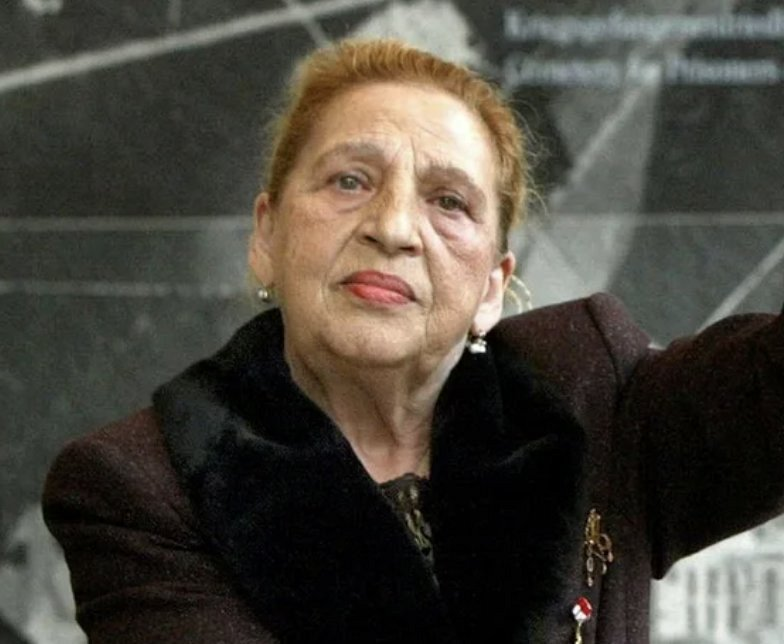
From there, Stojka, her mother and two sisters were transferred to Ravensbrück, a concentration camp about 100 kilometers north of Berlin. In January 1945 they were deported again, this time to Bergen-Belsen, where they remained until liberation in mid-April. When they returned to Vienna, they found their brothers alive.
In Auschwitz, numbers had been tattooed on their arms. Ten-year-old Ceija’s number was Z6399. The letter Z designated Roma inmates like herself. In 1948, Austria’s Interior Ministry issued an order concerning the « Gypsy nuisance » that called for the expulsion of stateless Roma. In the 1960s, after a long struggle for recognition of the Roma genocide, Austrian Roma began receiving compensation.
Stojka raised four children and made a living selling carpets. Nomadic life gave way to permanent residence. She only began telling her story, writing and painting in the late 1980s, at age 55, and as though everything had happened the day before. She died in 2013.
Every brushstroke in Stojka’s work resonates with what my parents experienced, knew and recounted. The dead and the living crowded together. Masses packed tightly beside the barracks and the gas chambers. And the Nazis, smiling broadly, watched those marked for deportation and whipped them.
Stojka paints their heavy boots and, here and there, it seems to me, their smiles. The smiles seen in photographs of Nazis abusing their captives or watching them march toward freight cars filled me, from childhood, with revulsion, contempt and hatred. Stojka excels at releasing those emotions, which strain against the limits of language, and channeling them into paint.
A smile by itself is not violence. But the smiles documented in videos uploaded by IDF soldiers themselves to social media – beside bound and blindfolded Palestinian detainees, or in front of destroyed villages and neighborhoods – feel like knives in my parents’ backs.
In Gaza, it is not ravens, but the rats. And they’re very real.
Stojka painted flocks of ravens drawn by the smell of corpses. In her work, thesebirds become symbols of the inexhaustible cruelty of the murderers and of death itself, on which she wrote : « Even death is terrified of Auschwitz. »
On the persecution and discrimination Roma continued to face after the war, she later wrote : « I’m afraid that Europe is forgetting its past and that Auschwitz is only sleeping. »
In Gaza, it is not ravens, but the rats. And they’re very real. After gnawing at human remains beneath the rubble, they raid tents where the living shelter and seek their flesh as well. As a daughter of survivors, I devoured Holocaust literature throughout my childhood and adolescence. I remember descriptions of rats in the Warsaw Ghetto and in the sewers. I remember my father describing, with helpless disgust, rats scurrying between his legs in the ghetto where he was incarcerated for three years. As a daughter of survivors, I recognize the callousness and arrogance of denial when I encounter it.
Stojka painted metaphorical fire and people flying through flames. In Gaza, a world has vanished in smart bombs and foolish shellings. She painted faceless figures behind barbed wire, barbed wire without people, and eyes without faces. But Amal’s almond-shaped eyes, Mustafa’s high forehead, Samir’s pipe and laughing squint, and Yaffa’s dimple complete the features of everybody else in Gaza.
Every living person there has lost dozens of relatives and friends, if not more. Before the war, Israel confined 2.3 million people to 365 square kilometers. Today, after subtracting the Yellow Line and Orange Line, about 120 square kilometers remain, where roughly 2 million people are confined– after deducting the dead, the bodies decomposing without burial, those rotting in prisons, and those who managed to escape.
As the daughter of Holocaust survivors, I know that a holocaust does not simply happen. It is perpetrated. And for that, far more is required than a few leaders and commanders, heavy boots and smiles.
As a member of the Israeli Jewish society perpetrating holocausts, I sank onto the bench at the center of the room in The Drawing Center, and Stojka’s paintings told me about Gaza, too.
