


1. Introduction: The Persistent Logic of Capital
In the contemporary theatre of political economy, a seductive and pervasive narrative has taken hold: the proclamation that we have transitioned into a fundamentally “post-capitalist” or “technofeudal” era. Proponents of this view argue that the ephemeral nature of data, the ubiquitous dominance of global platforms, and the predictive prowess of artificial intelligence have rendered the capitalistic laws of economics obsolete. They point to a world where 96% of the global population accesses the internet via mobile devices—part of a staggering demographic of 6 billion mobile users within a global population of 8 billion—as evidence of an epistemological break from the industrial past.
However, for the Marxist economic theory, these phenomena represent not a departure from capitalism, but its most intensive, refined, and technologically mediated manifestation. The “Digital Veil” serves to obscure the underlying metabolism of capital, yet beneath the sleek interface of the algorithm, the “Laws of Motion” identified by Karl Marx remain the heartbeat of the global system. To demystify the digital economy, one must move beyond the superficiality of “innovation” and utilize the strategic framework of the Law of Value and the Circuit of Capital.
The central thesis of this analysis is that the digital economy is not a transcendence of the capitalist mode of production but its ultimate realization through advanced constant capital. The Circuit of Capital—expressed by the formula M–C…P…C’–M’—remains the invariant structure of our age. Capital (M) is advanced to purchase commodities (C), comprising the means of production (data centers, fiber optics) and labor power, to initiate a production process (P) that yields enhanced commodities (C’) containing surplus value, which must then be realized as increased money (M’). This trajectory, from the definition of digital infrastructure to the critique of its most prominent detractors, reveals that to understand the “new” economy, we must first master the law of value that governs its every movement.
2. Defining the Digital Frontier: Taxonomy and Evolution
A precise taxonomy is required to avoid the pitfalls of technological determinism—the fallacious belief that technology dictates social forms independently of class relations. The digital economy is a “General Purpose Technology” (GPT) that reconfigures social infrastructure across four distinct, yet interlocking, layers of valorization:
- The Infrastructure Layer: This constitutes the physical bedrock of digital capital. It includes the submarine cables, 5G base stations, and satellites that form the global nervous system. Crucially, it encompasses “Cloud Capital”—the massive data centers (AWS, Azure, Google Cloud) that serve as the modern factory floor for data processing and storage.
- The Platform Layer: Functioning as the “Advanced Commercial Capital” of our era, these intermediaries (Amazon, Uber, Airbnb) connect fragmented markets and dictate the terms of exchange. Their primary logic is “Data Extraction,” serving as a digital sieve through which all market activity must pass.
- The Application & Content Layer: This is the site of the user interface (UI), where Software as a Service (SaaS) and social media (Meta, TikTok) harvest behavioral data. It is the interface where the consumer is integrated into the circuit of capital.
- The Intelligence Layer: The algorithmic “brain” (OpenAI, Gemini), consisting of Deep Learning and Large Language Models (LLMs). This layer transforms raw data into actionable value, selling “Intelligence-as-a-Service” to industrial and commercial actors alike.
The evolution from Web 1.0 (the “Read-only” information retrieval era) to Web 2.0 (the “Platform Turn” of user-generated content and targeted ads) and finally to the current Algorithmic/AI Turn marks the progressive sophistication of capital’s “Constant” component. In this third stage, the business model shifts toward the renting of computing power and decision-making capabilities. Far from replacing the Law of Value, these layers serve as the modern “Constant Capital” through which that law operates with unprecedented velocity. They are the physical embodiment of a system designed for the relentless pursuit of surplus value.
3. The Law of Value: From Steam Engines to Artificial Intelligence
Marx’s analysis of the Industrial Revolution was an extraction of the logical laws governing the capitalist mode of production, applicable whether the motive power is steam or silicon. At the core of this analysis lies Socially Necessary Labor Time (SNLT)—the time required to produce a commodity under normal social conditions with average skill and intensity. In our digital age, the value of a software-driven service is still fundamentally anchored in Abstract Human Labor.
The dialectic between productive force and the value-form creates a relentless competitive imperative. As technology increases productivity, the SNLT per unit decreases, causing the value of individual commodities to fall. This drives the capture of Extra Surplus Value. The mechanism is precise: an “innovative” capitalist adopts a superior AI algorithm, allowing them to produce at an Individual Cost Price lower than the social average. By selling at the Market Price (which is dictated by the social average), they capture a surplus profit. This “Individual Price of Production” logic compels all competitors to follow suit or face devaluation and exit, ensuring the continuous modernization of the means of production.
Furthermore, capital revolutionizes the production process through the application of science, thereby stripping the worker of autonomy; the worker ceases to be the master of the tool and becomes a mere ‘living appendage’ to capital. Marx identified this as the transition from the ‘Formal Subsumption’ of labor to the ‘Real Subsumption of Labor to Capital.’ While the former involves capital subsuming existing labor processes, the latter—characterized by the ‘automatic factory’—constitutes the emergence of a specifically capitalist mode of production that begins with the Industrial Revolution in England. In the contemporary era, AI and Cloud computing represent the apotheosis of this trajectory. Intellectual agency is increasingly centralized within the algorithm—a digital architecture that dictates the pace, intensity, and fundamental nature of labor, ensuring the total valorization of every moment.
4. Digital Transformation as a Catalyst for Industrial Productivity
Industrial capital’s survival depends on “Digital Transformation” to reduce operational costs and increase the rate of exploitation. This is an empirical reality: investments in industrial digital transformation are growing by 15–20% annually, leading to a 10–30% reduction in operational costs.
Six Dimensions of Digital Industrial Transformation
- Operational Excellence (IIoT & Big Data): Sensors identify “bottlenecks,” allowing companies like Siemens to increase output eightfold. This minimizes wasted labor time and maximizes value extraction.
- Predictive Maintenance (AI & Cloud): Rolls-Royce’s “TotalCare” monitors jet engines in real-time. This prevents the Devaluation of Constant Capital by ensuring expensive machinery does not sit idle or break down.
- Collaborative Robots (Cobots): In Tesla or BMW factories, robots handle repetitive tasks, reducing labor costs by 20–30%. This increases the Productive Force, lowering individual cost-prices.
- Algorithmic Management: Amazon’s software calculates exact walking paths. This is the pursuit of Relative Surplus Value—intensifying work within the same timeframe to squeeze value out of every second.
- Digital Twins: BioNTech uses simulations to optimize production. This reduces the SNLT in R&D, minimizing the risk of capital loss before physical production begins.
- Cloud-based Supply Chain: Apple manages thousands of suppliers in real-time. This reduces Circulation Time, ensuring surplus value is converted back into money as quickly as possible.
These technologies do not replace the Law of Value; they validate it. They are weapons used by individual capitals to compete for surplus profit by driving production costs below the social average. Whether through Foxconn’s nano-vision AI or Amazon’s path-calculating software, the objective is identical: the subordination of human labor to an algorithmic regime that minimizes wasted time. This transition from production to the realization of value brings us to the role of the platform.
5. Advanced Commercial Capital: Platforms and the “Salto Mortale”
In the Marxist framework, the realization of value—the transition from commodity back to money (C’–M’)—is a “death-defying leap” or “Salto Mortale.” If a commodity fails to sell, the labor embodied within it is socially wasted, and the capital is lost. Digital platforms function as “Advanced Commercial Capital,” serving as the ultimate safety net for industrial capital by shortening circulation time and ensuring the leap is successful.
This is not a historical mutation but an evolution. Just as the Department Stores of the 19th century (like Le Bon Marché) and the Sears Catalog (the “Analog Search Engine” of its day) utilized Scientific Management (Taylorism) to rationalize consumption, modern platforms use data to optimize the turnover of capital. By shortening the time a commodity sits in a warehouse, platforms allow industrial capital to turn over its investment more frequently, vastly increasing the Annual Mass of Profit.
A pivotal feature of this stage is the “Free Gift” of data. Marx observed that capital treats natural forces, such as waterfalls or fertile land, as a “Free Gift of Nature.” In the digital age, consumer data—harvested through social interactions, searches, and locations—is treated as a “Free Gift of Human Living.” This byproduct of human activity fuels algorithms for Precision Targeting (Upsell and Cross-sell), ensuring that the C’–M’ transition is nearly instantaneous. With global B2B e-commerce reaching $32 trillion and retail e-commerce surpassing a 20% global share, the digitalization of the “Salto Mortale” is the primary engine of modern commercial dominance.
6. Differential Rent and the “Freemasonry” of the Bourgeoisie
The fees paid to Big Tech—whether via SaaS subscriptions, pay-per-use utility models, or licensing—are frequently misinterpreted as feudal tributes. In reality, they are a specific form of capitalist Differential Rent. This rent arises because a capitalist (the platform owner) possesses a monopoly over a superior means of production (the Cloud or a proprietary algorithm) that allows the renter (the industrial capitalist) to produce or sell at a cost below the social average. The resulting “surplus profit” is then shared with the platform owner in the form of rent.
These are “Artificial Monopolies,” maintained by high switching costs and intellectual property laws rather than physical land scarcity. While these monopolies are “extended temporary” states, they remain subservient to the Law of Value. Competitive pressure eventually forces the “Generalization” of technology (witness the challenge of Open Source and Google Docs to Microsoft’s earlier hegemony), and disruptive forces like Decentralized Computing (P2P, Blockchain) continually threaten to dissolve these rent-seeking barriers.
The most profound aspect of this arrangement is what Marx called “A Real Freemasonry” (eine wahre Freimaurerei). While individual capitalists compete like “enemy brothers” for their slice of the “surplus value cake,” they remain a unified class in the collective exploitation of the global working class. The redistribution of surplus value—from the factory owner to the platform titan—does not change the source of that value: the unpaid labor of the worker. They are all shareholders in a global enterprise of exploitation, united in their metabolic need to expand capital.
7. A Critique of Technofeudalism: Why Varoufakis is Wrong
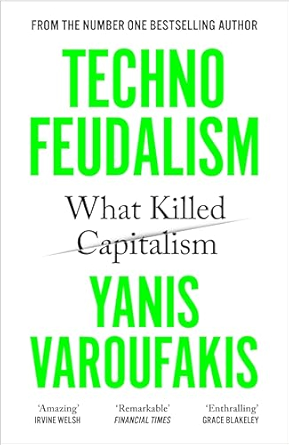
The “Technofeudalism” hypothesis, popularized by Yanis Varoufakis, argues that the “Cloud” has replaced the “Market” and “Rent” has replaced “Profit,” signifying the death of capitalism. This analysis, while rhetorically sharp, is an analytical failure that misinterprets the most advanced stage of capital for its demise.
| Technofeudalism View | Marxist Rebuttal |
| Cloud Fiefs: Platforms replace markets as the site of economic activity. | Constant Capital: The Cloud is a revolutionary evolution of constant capital (means of production) used to intensify market competition. |
| Cloud Rent: Rent replaces profit as the primary driver of the system. | Differential Rent: Rent is not a replacement for profit; it is a redistribution of the surplus value already produced in the industrial sector. |
| Cloud Serfs: Users produce value for free, replacing the waged worker. | Exploited Labor: Value still hinges on productive labor (P). User data is a “Free Gift” or byproduct of consumption, not the source of new value. |
To declare the death of capitalism because of the rise of Cloud Rent is to ignore the P in the circuit of capital. The “Cloud” is not a feudal manor; it is a “factory without walls” that coordinates global production. The industrial capitalist paying rent to Amazon is not a “vassal” but a partner in a more efficient regime of labor subsumption. “Technofeudalism” fails to see that the algorithm is the most capitalist tool ever devised.
8. Conclusion: The Enduring Power of Marxist Analysis
The digital economy, despite its algorithmic complexity and the “Digital Veil” of its interfaces, remains governed by the Laws of Motion of Capital. The strategy of the modern bourgeoisie has not changed since the 19th century: to reduce Socially Necessary Labor Time, to accelerate the turnover of capital, and to maximize the extraction of relative surplus value.
Whether through the “Real Subsumption” of the worker to the AI system or the capture of “Free Gifts” of data, the system remains a “Real Freemasonry” of exploitation. The task of the scholar is not to be dazzled by the “newness” of the digital age, but to expose the age-old logic of capital that resides within the algorithm. To understand the digital economy as an advanced stage of capitalism is a strategic necessity for identifying the true sites of struggle. The task of the Marxist economist remains clear: to strip away the digital veil and expose the exploitation that the algorithm was built to hide. The struggle for the value of human life remains, as it always was, the central conflict of our time.