

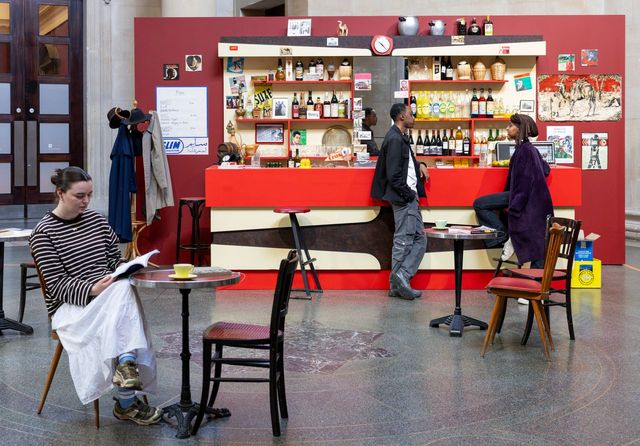
At first sight this exhibition does not look like an art show. You see a large noticeboard like you might see in a student project with a map of Africa with lines leading to information on different countries. There are magazine and newspaper cuttings too. Moving on there is a mini cinema with a film running featuring quite an old blind person. Then you are in the middle of a French/Algerian bar from the 1960’s that has a jukebox (Scopitone) with an old style TV above it with linked films. Near this there is a long table with heaps of film junk. At the far end you find a VW type camper van that looks like it is used as a film workshop. Behind that you find a pile of cushions where you can sit and listen to somebody telling stories with a mountainous landscape as a backdrop.
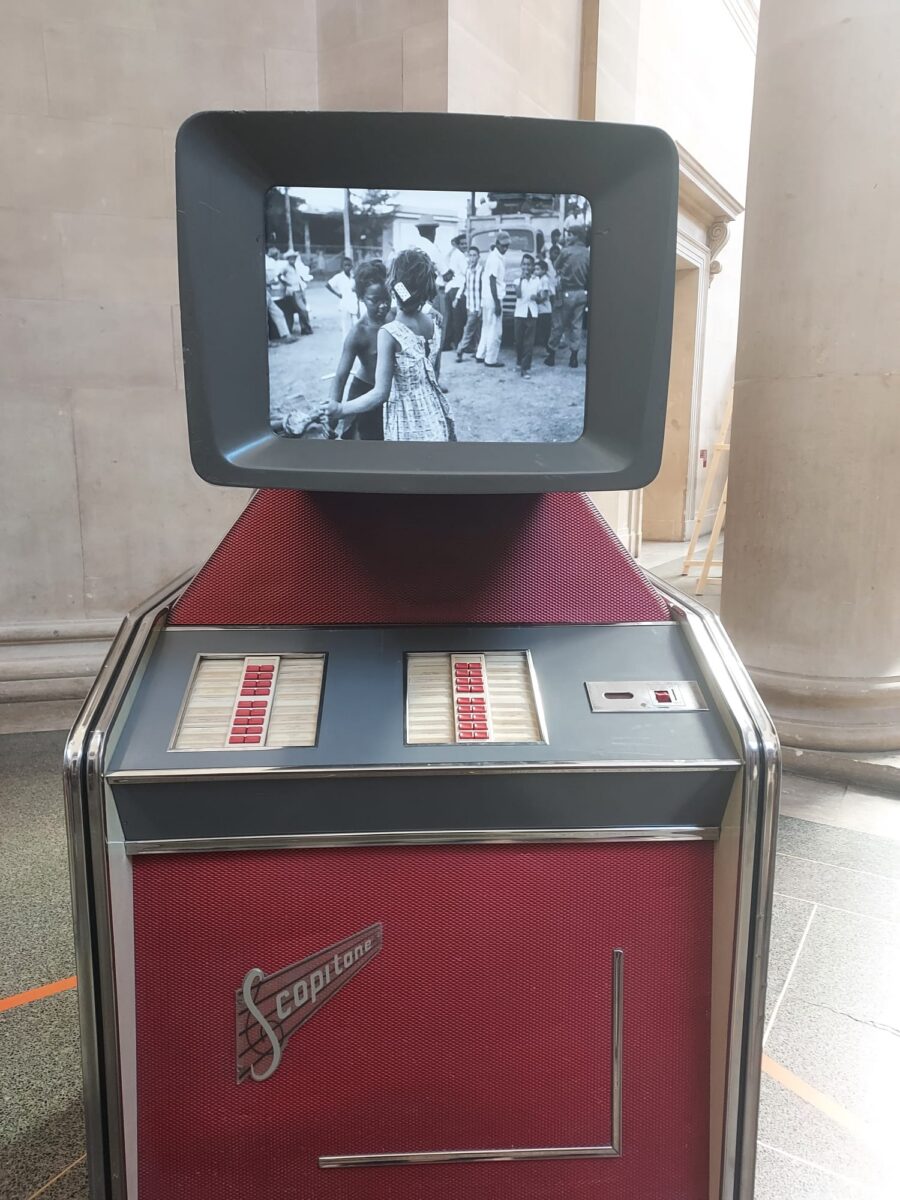
What is it all about? It is an installation made by Algerian/French/British artist Zineb Sadira (b 1963) that aims to recreate a particular period in political and cultural life in Algeria after the victory against the French colonialists in 1962. The Algerian Cinematheque was a radical institution that brought together national, Africa and European filmmakers. Zineb was a child at the time but she remembers the cafes, the cinemas and the films of the time. She also draws on the memories of her family to recreate this revolutionary period. The Cuban revolution had been victorious just a few years before and it too had become a magnet for radical socialists and anti-imperialists throughout the world,. There was quite a lot of contact between these two centres at that time. On the jukebox TV you see scenes of people dancing in Havana and the noticeboard has pictures of Fidel and Che.
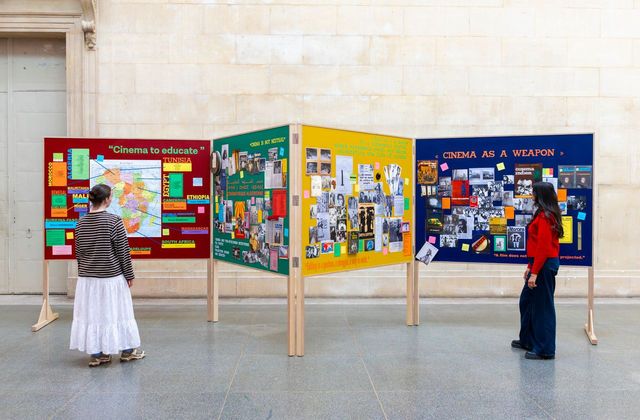
The revolutionary period in Algeria is also part of the history of our political current. Comrades in France, Belgium and Holland in particular had thrown theselves into active solidarity with the FLN, the Algerian national liberation movement. It was a bloody struggle with the French state which used the full might of imperialist counter insurgency. The Battle of Algiers (1966) made by the Italian Gillo Portocorvo is a classic film showing the reality of the struggle. It is on the information board. In France the film provoked violent attacks by the extreme right wing OAS which carried out terrorist attacks against the FLN and their left wing supporters in Algeria and in France.
Comrades carried suitcases of money (porteurs de valise) for the FLN and a leader of the Fourth International, Michel Pablo (real name Raptis), with a team of comrades set up an arms factory in Morocco. He was imprisoned for a while in Holland for printing counterfeit money for the FLN. During the post 62 revolutionary period Pablo was an important advisor on land reform for the Ben Bella government..
Unfortunately in June 1965 the minister of defence, Boumedienne, carried out a bloodless coup d’etat ousting the radical Ben Bella who was close to Pablo. The latter managed to get out in time. Since then there was a bloody civil war from 1992 to 2002 between the historic military leadership and the Islamic Salvation Front, who had won elections but were prevented from taking power. 200,000 died.
As Zineb said to me at the press preview the regime today is authoritarian and very little remains of the cultural and political ferment of the 1960s.
This artist has worked like a curator or documentarist to allow us to remember and discuss this special time in Algerian history. Sometimes the role of the artist is to preserve a memory so that its truth is not erased and it can be kept alive for the left, anti imperialists and progressive people. It takes more work and creativity than it looks to re-assemble artefacts from the time. You have to sweat in archives to find interesting examples of the militancy and creativity of the time. In the exhibition she also simulates the traditional culture of story teller to recall the narrative of the period (see screen behind camper van).
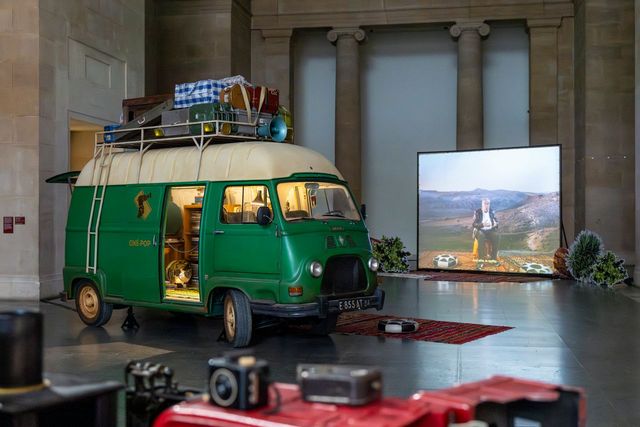
The cine-VW bus system had been used by the French colonial regime so the new authorities were able to take it over so that they could bring cinema to the masses, travelling from village to village. The mechanics of the cinema then was much, much less flexible and mobile than it is today. You had to lug around very heavy canisters of film. At the time there were also shortages in Algeria so film makers from abroad were encouraged to bring in as much as possible. Today we can make meaningful short films on our smart phones and it can be transmitted across the world in seconds. No wonder authoritarian regimes like Iran, Russia or Israel stop the internet being used by the people they oppress. Mass consumption of smart phones makes a lot of money for Big Tech but they can also be a weapon in the struggle.
Cinema preserves memory and crosses frontiers. In her presentation the artist emphasised how lucky she was to find somebody still alive from the time of the cinematheque. We see a film in the little cinema she has created in the Tate’s Duveen galleries that poignantly features a cineaste who had become blind later in life talking about the cinema of that time.
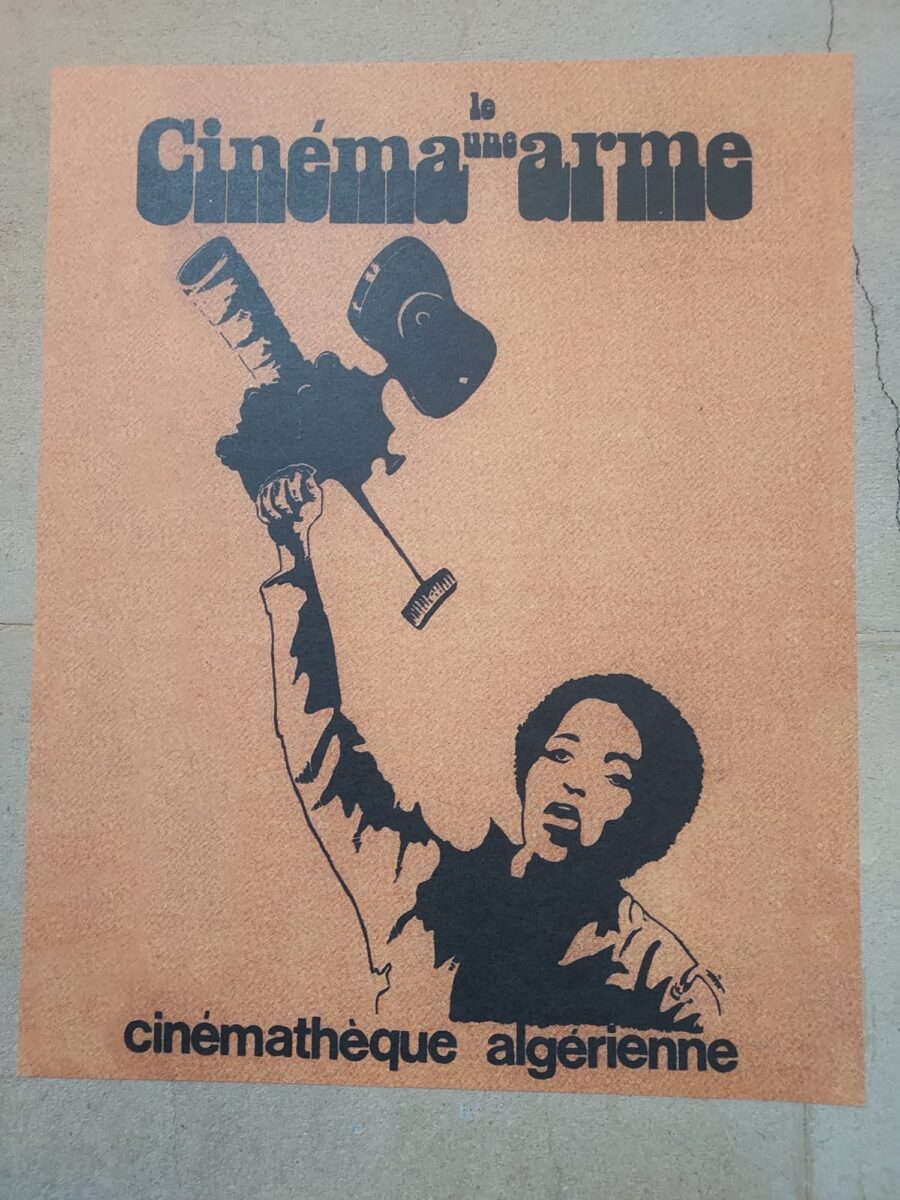
Film can be a very internationalist art form since it is based on images with subtitles that are easily accessible. Another point she emphasised in her remarks was how this period was also about a pan-African approach to culture and anti-colonialism. In this era the struggles from south of the Sahara linked up with what was happening in a predominantly Muslim North Africa. Of course at that time Marxism dominated over any Islamist currents in the leadership and politics of national liberation movements.
“By keeping histories alive, her storytelling becomes both an act of resistance and a gesture of connection, affirming her place as a significant and influential voice in today’s cultural landscape.”
(from the Tate press release for this show)
“Taking on the Tate Britain Commission feels both monumental and intimate. It’s about bringing the weight of history into dialogue with the living pulse of the Pan-African experience. It gives me the opportunity to imagine new stories, new energies, and new meanings.” Zineb Sedira
Zineb is truly an artist that is internationalist in her work. She represented France at the 59th Venice Biennale in 2022 with Dreams Have No Titles, a critically acclaimed installation inspired by militant cinema and her family’s immigrant journey.
This show is on view until 17 January 2027, this will be the artist’s largest commission in the UK to date. It is completely free and is well worth a visit. You could catch it before or after a demonstration or meeting since it is in a central location.