

This conference was co-organised by AntiCapitalist Resistance, Ecosocialist Action Network and Greens Organise, and marked a positive step forward in coordinating across the left wing of the climate movement.
Paris Wilder, from AntiCapitalist Resistance, EAN and the conference organising committee, opened the first plenary of the day. Her speech linked together the main themes of the conference, the failure of politicians to halt climate breakdown and the way capitalism as an economic system is driving us to ecocide. She told participants,
“A capitalist system functions on growth alone at any cost. But it is not the growth of knowledge, love, community or the incredible ecosystems and species that we share our planet with. It is concerned only with the growth of profit for the ultra rich, the tech billionaires pushing massively destructive, and inherently exploitative, technologies like AI. They do this at the expense of human life and the planet itself.”
This first plenary focused on the fight for climate action at the ballot box. Claire LeJeune from La France Insoumise (France Unbowed) talked about the united struggle to block Le Pen and the far right in France, where the Rassemblement National (National Rally) has a large parliamentary presence, and hopes to win the Presidency in 2027. Mel Mullings, an RMT activist and Your Party candidate in the recent council elections, gave a powerful presentation about how global warming was impacting London underground workers by increasing train temperatures and increasing the threat of flooding at some stations. James O’Nions spoke from Greens Organise on their current campaign and how they were working to consolidate ecosocialist politics within the Green Party.
Workshops
The conference then broke off into three concurrent sessions. In the session ‘A Green Transition and Radical Abundance’, we heard Fred Pearce, former environmental consultant for New Scientist Magazine, speak about how new technologies could be adapted in a transitional society moving away from capitalism, and why we can’t wait for a revolution to fight for reforms to fossil capitalism now. Martín Lallana, a member of Anticapitalistas in the Spanish State, gave a talk on the debates around transitional economics and the role of planning in ecosocialism.
There was a useful discussion around lifestyle changes and the need to focus on social norms rather than individual consumer habits, drawing parallels with banning smoking in public places and how that approach can help win people over to a more sustainable way of life. Audience contributions looked at the question of localism, including cooperatives and their limits, as well as what demands can be put on the state to act, and the challenges around that.
The opening speaker in the session ‘Big Tech, AI and the Climate Crisis’, socialist writer and activist Anne Alexander, spoke about Russian revolutionaries Lenin and Bukharin, and integrated their thinking into what AI might mean for the working class in 2026. Socialist economist James Meadway then discussed in detail how data centres are impacting local communities and housing planning due to the energy needs of data.
Dan McQuillan, author of ‘Resisting AI: An Anti-fascist approach to AI’, began his discussion by saying: “I’d like to say that AI is actually very shoddy as technology and error prone”. It was not only a “don’t believe the hype” talk but also a “resist AI” intervention. The discussion provided lots of food for thought on an issue that is rapidly becoming one of the most important with regards to climate breakdown; the conference steering group encourages you to invite this trio of speakers to your town or city to explain what is really going on with AI.
There was also a panel led by Sara Arnold of Fashion Act Now, on the environmental impact of fast fashion and how people are organising along the supply chain. Ruth Ogier from War on Want explained the key findings of the campaign’s recent report, Extraction Fashion. The richness of the report and Ruth’s summary meant that the session could easily have run for much longer.
Dr Neelam Raina from Middlesex University and Independent Design Researcher and Practitioner Dr Talia Hussain also gave their insights into how the global supply chain feeds poverty and exploitation in the global south, as well as environmental devastation through production, distribution and waste. Audience contributions raised important lessons of co-organising consumers and garment workers, as shown through the ‘No Sweat’ campaign, as well as debates on whether boycotts were useful in this area and questions of gender which were not addressed in the speakers’ presentations.
After lunch, in the session on the far right, A.J.A Woods introduced their new book on the cultural Marxism conspiracy theory and why the far right are climate change deniers. They argued that we shouldn’t just see the far right as cynical operators motivated by financial gain, but that their ideology is embedded in the exploitation of people and the planet by capitalism. They spoke of the reality of ‘denialism’ that is not always conscious, but that to accept climate change is to make a break with the world as we know it, and for those embedded in capitalism, this is unthinkable.
Sophia Brown from Greens Organise spoke about the myths around climate migration, the dangers of fixating on it as a kind of apocalyptic moment, and how the mainstream media pushes a narrative of migrants as a symptom of climate change and not as victims of capitalist greed. She spoke of how we cannot make snap judgements that certain migration is purely climate related, but we must instead look at all the variables surrounding it.
Stuart Jordan – an NHS worker and trade union activist – ran an engaging workshop on how to organise around health and safety issues, with a particular focus on transport worker heat strikes. The discussion focused on how to practically mobilise workers, as well as how to coordinate across campaigns and workplaces.
In another parallel session, Hamza Hamouchene (author of Dismantling Green Colonialism) and Kimia Talebi from Energy Embargo for Palestine spoke about ecocide and war. Hamza focused on Palestine, putting today’s ecocide into the broader context of Israel’s greenwashing – part of its attack on the Palestinian people going back decades. While his focus was on Palestine, he also drew parallels between these experiences and those of other communities under imperialist attack. His slides were absolutely absorbing and we hope to be able to share them here, as well as with a wider audience of Palestine campaigners. Hamza emphasised the role of the Jewish National Fund – recognised as a charity in Britain and elsewhere – as a key actor in the colonisation, the genocide and ecocide. Kimia explained the basis of the campaign and talked more about the current situation in Gaza. While both presenters overran, it seemed that the audience were happy to listen, though there was a brief exchange about how we could all work to strengthen links between the Palestine and climate struggles.
Organising
In the final round of workshops, the session on how to organise the climate movement heard from Simon Pirani about the challenges facing human society, fighting for social justice and escaping from the tyranny of capitalism after 40 years of neoliberalism. He spoke on behalf of Fare Free London on radical changes to how public transport could be funded to make it free and accessible for everyone as a way that benefits individuals and communities and disincentivises excessive car use.
Tyrone Scott, campaign organiser from War On Want, spoke about the need to embed climate demands in diverse campaigns and how to build alliances. There was discussion about how organising against the far right is also a form of climate organising, as many of those funding right-wing parties are also the ones benefiting from climate breakdown.
Sophia Brown from Greens Organise spoke about the limits of what councils can and cannot do, as well as a national, emergency anti-austerity summit being called for autumn 2026, which will incorporate broader ideas about ecosocialism. She also spoke about the intersection between climate justice and migrant justice, and possible divestment strategies on pensions committees of local councils. The organising session then broke into smaller discussion groups to share ideas and participants’ own experiences of organising. The groups reported back, with recurring themes including local networks and alliances across campaigns and organisations. Attendees also noted how climate change demands are often working class demands, such as the cost of energy and transport and the need for affordable, insulated housing.
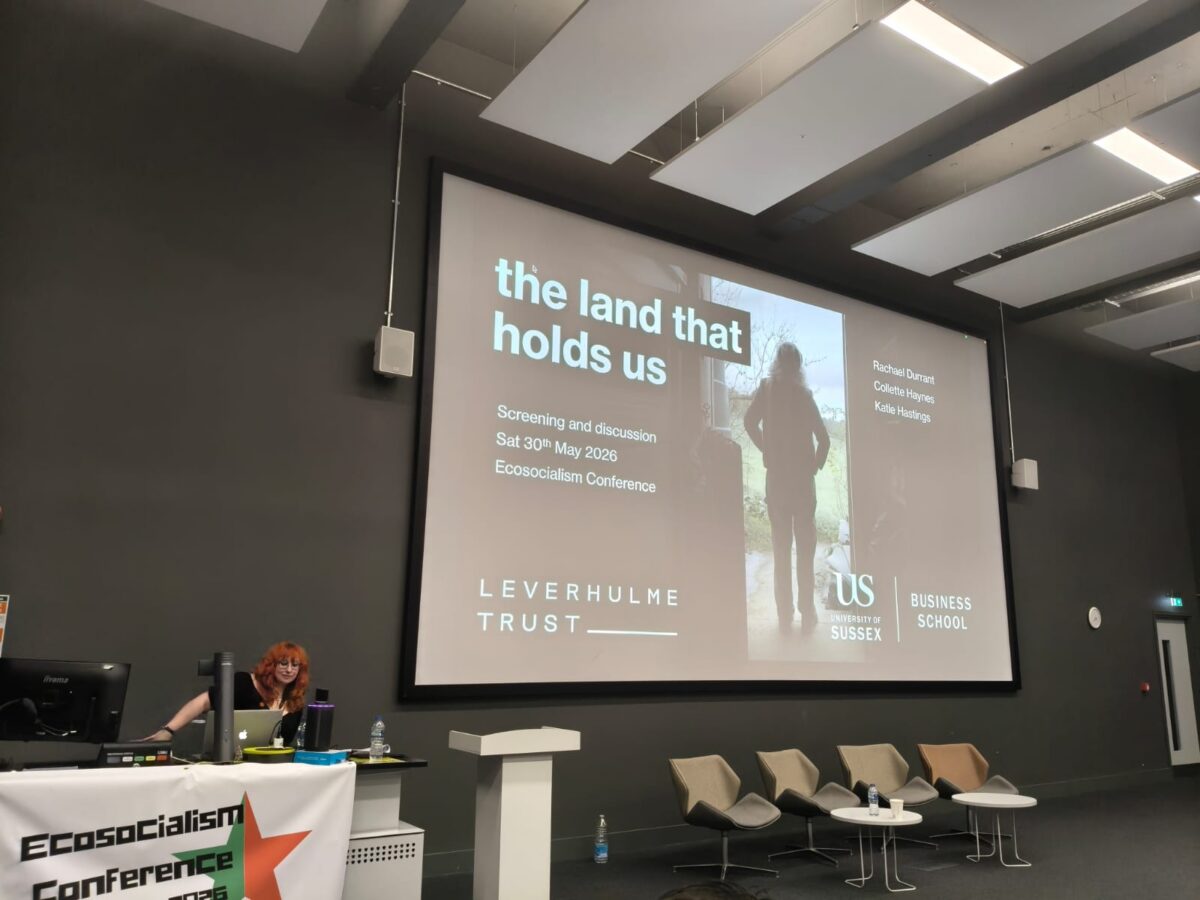
Alongside the climate organising workshop, attendees gathered in Southwark Theatre for a film screening and discussion by Rachel Durrant, a researcher and filmmaker working at the Science Policy Research Unit at University of Sussex. The film focused on the realities of women in agroecology, looking at damaging gender stereotypes, the battles between small-scale organic farming and large supermarkets and the therapeutic benefits of ‘getting back to the land’. Durrant then led a discussion with conference attendees, as well as two of the film’s contributors, asking important questions about gender and ecology, and how we build a sustainable future.
Sadly, Michael Löwy couldn’t join us for the final session. However, he sat down with Simon Hannah ahead of the conference to record an interview discussing his ideas behind The Ecosocialist Manifesto (2001) and why we need ecosocialism more than ever. The interview was then screened for attendees in the closing session.
Concluding the conference, Paris Wilder said,
“The climate is not, and should not, be a separate struggle to organise around. The ecosocialist movement aims to link the ecological struggle to the social crisis facing us as humans. Struggling for money at the end of the month and fighting to stop the end of the world are the same struggle directed against the same people.
We have to make the case for people to see the climate as pivotal to socialist organising and make the links. We can’t have a conversation about migration without the climate, we can’t have a conversation about trans liberation without the climate, we can’t have a conversation about housing justice without the climate.”
Paris announced that Ecosocialist Action Network has secured funds to set up local climate assemblies and wants to reach out to activists across the country to co-host these. The fight for climate justice happens on a local, national and international level, and mobilising people in their communities to make the links between ecology and social issues is going to be central to building a mass ecosocialist movement.