

D.K. Renton argues that Trump has not yet become a fascist. He is right. But his test can only detect fascism once it has already won.
D.K. Renton’s piece on Trump, fascism and Iran, published on this site on 10 April, is a serious contribution to a debate that ACR has been developing for some years. That debate has its own history here. Writing on this site the day after 6 January 2021, Neil Faulkner named it a fascist riot immediately, identified the three-part structure that made it possible, and argued that the creeping fascism framework ACR and comrades had been developing since 2016 explained what liberal commentators had failed to see coming. A year later, in January 2022, he identified the Supreme Court’s conservative domination, the voter suppression legislation moving through Republican state legislatures, and the hardened paramilitary organisations within the MAGA coalition as evidence of a trajectory that could produce a qualitative shift toward elective dictatorship. Much of what he predicted has since happened.
Renton does not reject that framework. He accepts that fascist tendencies are growing, that Trump could become a fascist, that the 1930s are in some sense being repeated, and that the worst outcomes have become more likely. His argument is more specific than a general rejection of the creeping fascism analysis. Trump does not currently lead a fascist regime, Renton argues, and the test for that threshold, continuous radicalisation combined with mass violence deployed against domestic enemies, has not yet been met. On that narrow point, and with the qualifications that follow, he is right. The question this piece wants to ask is what the analysis looks like if you apply it one stage earlier.
His central distinction is worth restating carefully: conservatives moderate in power because they do not need to purge the state, drawing instead on a pre-existing alliance with the ruling class. Fascists radicalise continuously, deploying mass mobilisation to bypass the sclerosis of bourgeois democracy. By that test, Renton argues, Trump fails. The Iran adventure fits an older pattern: every American president since 1990 has found foreign wars easier than domestic politics. Bush was not a fascist. Neither, yet is Trump.
That argument is largely correct. The problem is not with the test, but with what it cannot see.
Fascism builds before it arrives
Renton’s framework is state-centred. It watches governments cross thresholds. Which means it is watching the right thing, but only at the point where the evidence is already overwhelming. Fascism has never announced itself cleanly at the moment of power. It builds before it arrives: civil society infrastructure, media operations, international networks, cultural normalisation. By the time a movement passes Renton’s test, the preconditions are locked in. The test is retrospective by design. Fascism understood as a process means the analysis must begin before the seizure, not after it.
To be precise about what I am not arguing: the distinction between authoritarianism and fascism matters enormously, analytically and strategically. Collapsing every right-wing government into fascism produces the same error as denying fascism’s existence: it disables the ability to identify what is happening. Zarin’s three characteristics piece, also on this site, illustrates the risk. War as solution, militarised borders, abandonment of human rights frameworks: these are real phenomena, but they describe conditions under which fascism can grow, not fascism itself. They fit Erdogan, Orban, Duterte, Modi. If the category stretches that far it stops explaining anything.
The question is not whether Trump has crossed the line. The question is whether the political form capable of crossing it is already being assembled, and where.
Stages of creeping fascism
Ugo Palheta’s model of fascisation, developed in La Nouvelle Internationale fasciste, is useful here without being schematic. The first stage is not seizure but preparation: the building of ideological legitimacy, organisational infrastructure, and international network connections that make a fascist politics available as a solution when the crisis deepens. The second stage, if it comes, inherits what the first has built. Waiting for stage two before naming stage one is not analytical caution. It is a category error with political consequences, because what stage one requires is time and the absence of serious opposition. Renton’s threshold test and the creeping fascism framework are not incompatible: both reject the checklist approach, both take the direction of travel seriously. The disagreement is about where on the trajectory we currently are, not about the basic analytical tools.
Renton’s Bush comparison is the place where this matters most. His argument places Trump in a sequence: every president since 1990 found foreign war easier than domestic politics, none is remembered as their generation’s Mussolini. The sequence is real. The implication, that Trump therefore belongs to a normal series rather than an exceptional one, does not follow.
Bush did not arrive in office with an organised movement behind him. The Federalist Society had been building judicial infrastructure since the 1980s, but there was no paramilitary-adjacent street presence, no transnational ideological network with operational White House connections, no systematic attempt to delegitimise the electoral mechanism before deploying it. 6 January is the event Renton’s framework cannot absorb cleanly. It was not a fascist coup. It was a riot, a rehearsal, and rehearsals are stage-one phenomena. Writing on this site the following day, Faulkner identified its three-part structure: the mass electoral base Trump had built over four years, the hardened paramilitary organisations within it including the Proud Boys, Oath Keepers and Three Percenters, and the complicity of the existing state apparatus through deliberate police non-intervention. The cops were low in numbers, offered token resistance, and allowed the fascists to swarm into the building.
Contrast that with the policing of Black Lives Matter protests months earlier. The state and the paramilitary were not in tension on 6 January. They were coordinating. Bush never rehearsed anything equivalent because nothing equivalent existed to rehearse with. More precisely: Bush did not bequeath 6 January. Trump is building something his successor, whoever that is, will inherit. The comparison works at the level of presidential behaviour. It breaks down when you look at what each president inherited and what they leave behind.
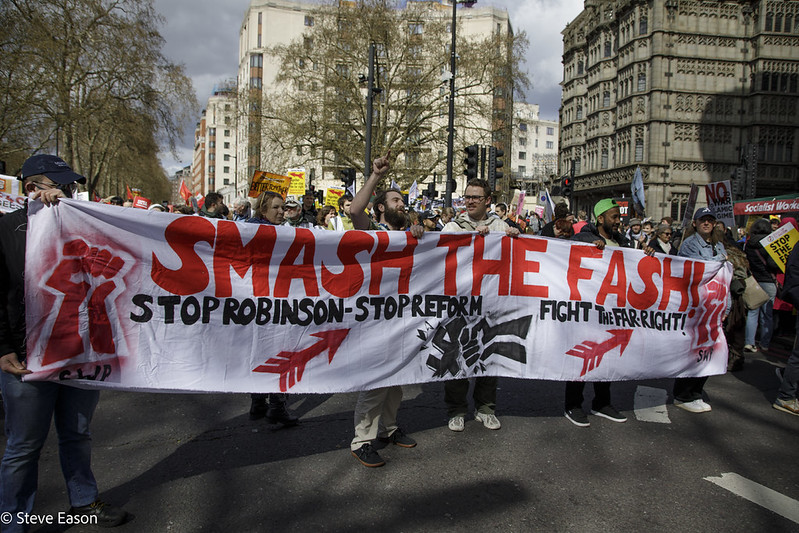
Supreme court’s role
Renton reads the Supreme Court’s tariff ruling as evidence of democratic constraint holding. The ruling is worth examining carefully, because it does not say what that reading implies. Trump did not lose to an independent judiciary operating as a check on executive power in the way the civics textbooks describe. He lost to a court that includes three justices he appointed, a court that has already dismantled abortion rights, gutted the Voting Rights Act, granted presidents broad criminal immunity, and overturned forty years of administrative law in a single term.
Faulkner correctly identified the court’s conservative domination as a central component of the authoritarian right’s institutional strategy, predicted that a Trump victory could produce a qualitative shift toward elective dictatorship, and named the voter suppression legislation already moving through Republican state legislatures as evidence of the direction of travel. Nobody knew the ruling was coming. The outcome was not guaranteed. The fact that even this court, reshaped over a decade of Federalist Society strategy, found the tariffs a step too far does not demonstrate institutional resilience. It demonstrates how close to the edge the institution has already been moved, and how much of the journey was made before the ruling that Renton treats as reassuring. A court that surprises you by ruling against the president it was built to serve is not a functioning democratic check. It is a floor that has not yet given way.
Minneapolis reads similarly. The movement pushed back and ICE withdrew. Accurate. The two protesters killed did not come back. The thousands arrested were not all released. The withdrawal was tactical, not a defeat of principle, and the infrastructure that enabled the operation remained intact. Renton reads Minneapolis as constraint. It can equally be read as calibration. He notes himself that for a domestic tyrant to consolidate power, war would need to generate sufficient popular support to use the army against enemies at home, and that Trump has not managed this with Iran. That opening is worth holding: the attempt is visible even if the outcome remains uncertain. Two dead protesters and thousands of arrests is not nothing. It is the beginning of a violence threshold being tested, not evidence that the threshold does not exist.
MAGA tensions
Renton also makes a serious argument about isolationism that deserves direct engagement. At CPAC, he notes, the main internal debate was whether to support or oppose the Iran war. Tucker Carlson and the Groyper tendency represent a genuine constraint on Trump’s war-making capacity, and Trump’s Venezuela operation was calibrated precisely to satisfy both wings: expansion without casualties, imperial gain without the cost that triggers isolationist resistance. The internal opposition has since widened. Alex Jones, Candace Owens and Marjorie Taylor Greene have all moved against the Iran war, each from within the MAGA coalition rather than from outside it.
Renton is right that this tension is real and that it constrains Trump in ways that matter operationally. What he does not say is what this opposition represents. The Groyper tendency he cites is, by his own acknowledgement, mimetic of interwar fascism. Jones, Owens and Greene are not liberal anti-war voices. Their isolationism is ethnic nationalist retrenchment, closer to America First 1940 than to any democratic tradition. The constraint they place on Trump is not a democratic check. It is a competing far-right tendency pulling in a different direction rather than a contrary one. That Trump must manage this tension does not make him weaker in the way Renton implies. It makes the movement around him more internally contested, which is a different thing, and not necessarily a stable one.
There is a further problem with treating Iran as simple displacement. Trump’s foreign adventure and his domestic authoritarian construction are not sequential, with one substituting for the other. They are simultaneous. The bombing campaign is happening alongside the systematic purging of federal institutions, the deployment of active-duty military against civilian protesters, and the construction of what William I Robinson identifies as a proto-fascist paramilitary apparatus in ICE. That apparatus does not operate in isolation from the far-right civil society networks that mobilised on 6 January: the same logic of recruiting from existing paramilitary formations, blurring the line between formal state violence and informal movement violence, runs through both.
Faulkner noted in January 2021 that the existing state apparatus is always the primary instrument of fascist-type repression, and that 6 January made the relationship visible. ICE makes it operational. Renton treats Iran as evidence that domestic politics proved too difficult. It may equally be cover for the domestic work, buying time and generating nationalist pressure while the apparatus is assembled. The two are not in tension. They are mutually reinforcing.
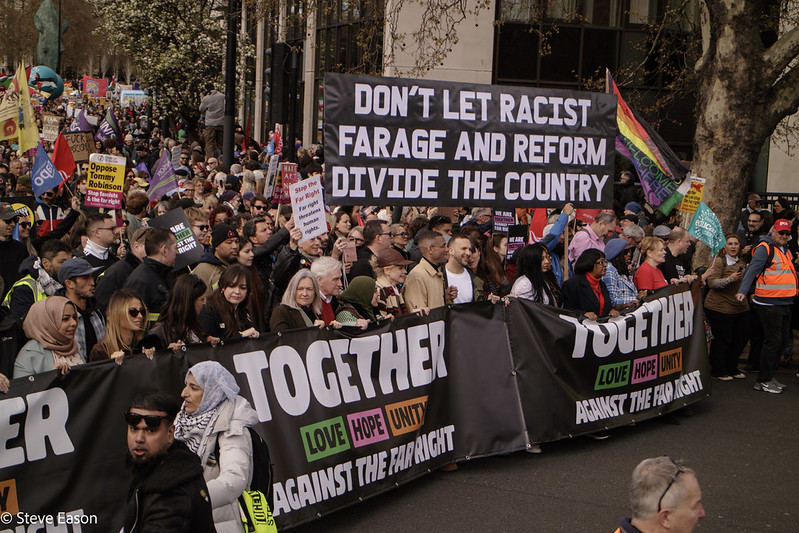
Renton’s most suggestive argument is one he does not fully develop. Writing about Israel and the United States, he argues that the presence of multiple right-wing authoritarian regimes causes each to radicalise faster: each seeks to be the leading power, each borrows from the other, each normalises what the other has done. He says there are more than two such regimes today. He is right, and the implications reach further than his piece follows them.
Mutual radicalisation
In Britain, the political form that Renton’s framework cannot detect is visible if you look at the right level.
Restore Britain is not in government. Rupert Lowe defected from Reform in early 2025 and has been building something with a different structure: not a parliamentary party competing for votes in the usual sense, but an organisation operating simultaneously as a policy shop, a media content operation, and a node in a European far-right network. A 133-page deportation document, detailed enough to function as a governing blueprint. A Facebook content operation running sustained anti-Muslim material at scale, with the demographic targeting precision that distinguishes an operation from a campaign. These are not the activities of a pressure group. They are the activities of a movement preparing to govern.
Harrison Pitt, Restore Britain’s head of research, attended a private event in Vienna alongside Renaud Camus and Martin Sellner. Camus is the originator of the Great Replacement theory that provided the explicit ideological framework for the Christchurch massacre, in which fifty-one people were killed, and which the perpetrator named his manifesto directly after Camus’s work. The theory has since scaffolded attacks in El Paso, Buffalo and beyond. Sellner is the principal organiser of the Identitarian movement’s pan-European infrastructure. This was not a conference. It was a working meeting. Pitt’s presence there is documented. What it tells you is that the ideas being road-tested in Austria and France are not being observed from a distance in Britain. They are being imported and adapted. The transmission mechanism is personal and deliberate. This is exactly the mutual radicalisation dynamic Renton identifies operating between Israel and the United States, except it is happening below the level of governments, in the civil society infrastructure where stage one is built.
By Renton’s test, none of these registers. Restore Britain has not seized power, has not cancelled elections, has not deployed mass violence against domestic opponents. Correct. Those would be stage-two phenomena. Stage one is already visible.
How valid is the Mussolini comparison?
Renton notes that what made Mussolini’s victory possible was pre-power violence: hundreds of opponents murdered, printing presses smashed, deputies shot. That violence set the tone for what followed. He applies this as a test: for the fascist label to become accurate, a regime must continuously radicalise, crossing thresholds including mass violence against enemies in society and the state. The test is right as far as it goes. The question is what the absence of equivalent violence today actually tells us. Italian, German and Spanish fascism had to murder thousands of communists and socialists because they were armed, organised, and fighting for power. The biennio rosso had nearly swept Italy into revolution. The scale of the squadristi violence was proportionate to the scale of the threat the ruling class faced.
Today’s far right does not need to murder thousands of socialists because there are no thousands of socialists in that sense: no factory councils, no armed militias, no movement seriously contesting power in the streets. The absence of mass pre-power violence is not evidence against the fascist trajectory. It reflects the weakness of the opposition. A fascism that does not need to kill its way to power because the left is already dispersed and demoralised is not a less dangerous fascism. It may be a more confident one.
His distinction between fascism and conservatism is useful here too. Where conservatism placates different classes and interests, fascism uses popular anger to get past that constraint entirely. That is precisely what a content operation targeting anti-Muslim sentiment is doing. It is not winning elections. It is building the cultural ground on which a harder politics becomes available. The Facebook operation does not need to be directly traceable to a political programme to be doing political work. The work it does is prior to programme.
The infrastructure exists. Whether it finds its moment depends on conditions that nobody controls yet. The open discussion between rs21 and ACR that this exchange represents is itself part of what determines that. Getting the analysis right, and getting it right together, is how the left builds the capacity to intervene before stage two arrives.