
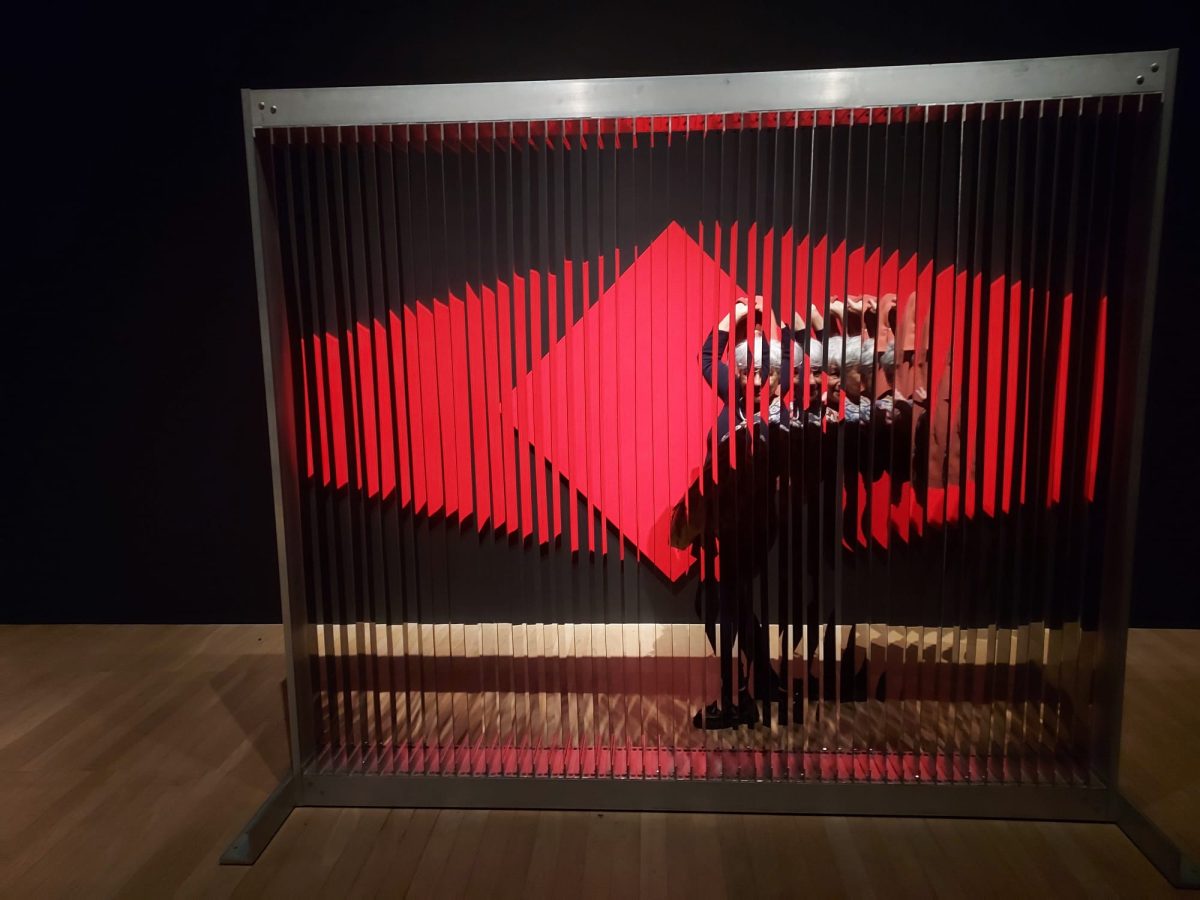
In this show you can walk behind Screen with reflective blades and you become part of the art. Your friends can join you too and it becomes socially shared art. It is fun and the image has its own beauty. It makes you reflect on your perception and how it can be distorted. Its effect depends on your movement. The actual art object is relatively anonymous, it could have been constructed by a team able to build an Ikea bookcase. Nobody tells you to keep your distance, it is not stored behind glass, you can touch it. If it gets damaged it can be repaired. You do not have to be a graduate to understand the artwork. Here is Julio le Parc’s contribution to art shown just in one exhibit.
This sort of interactive concrete art that makes the viewer a participant, a co producer of the artistic experience is two a penny in contemporary art exhibitions. Kinetic, immersive art was still relatively new when the Argentine born artist, Julio le Parc started producing it.
It was a conscious choice. He rejected the conventional notions of the passive viewer of precious art objects positioned in the great temples of art. Julio was born in Mendoza Argentina, son of a railway worker and a seamstress – he calls it a ‘simple’ family. He grew up with a sense of social differences and a questioning of authority,
He wanted to make art that was accessible and involved the viewer. He wanted to break down the walls of the art galleries and museums. Travelling to what he thought was a centre of the art world – to Paris – he was already organsing art events in the streets in the early 1960’s. With like minded artists he had set up GRAV in 1960 (Groupe de Recherche d’Art Visuel- GRAV). The group sought to explore perception, light and movement and to democratise art. In 1965 GRAV published Enough Mystificatioins, Stop Art, a manifesto rejecting art as an elite product and focussing on participation, experimentation and collective play.
‘These works illustrate a constant in my work: the indispensable presence of the viewer. Many of the experiences conceived then only acquire meaning through their participation. Some pieces envelop he viewer; others require them to pass through them; still others invite them not only to observe, but to physically experience them. In some cases, the viewer is even asked to complete surveys, making them an active participant in the artistic process’
Julio le Parc (p 10 Tate catalogue)
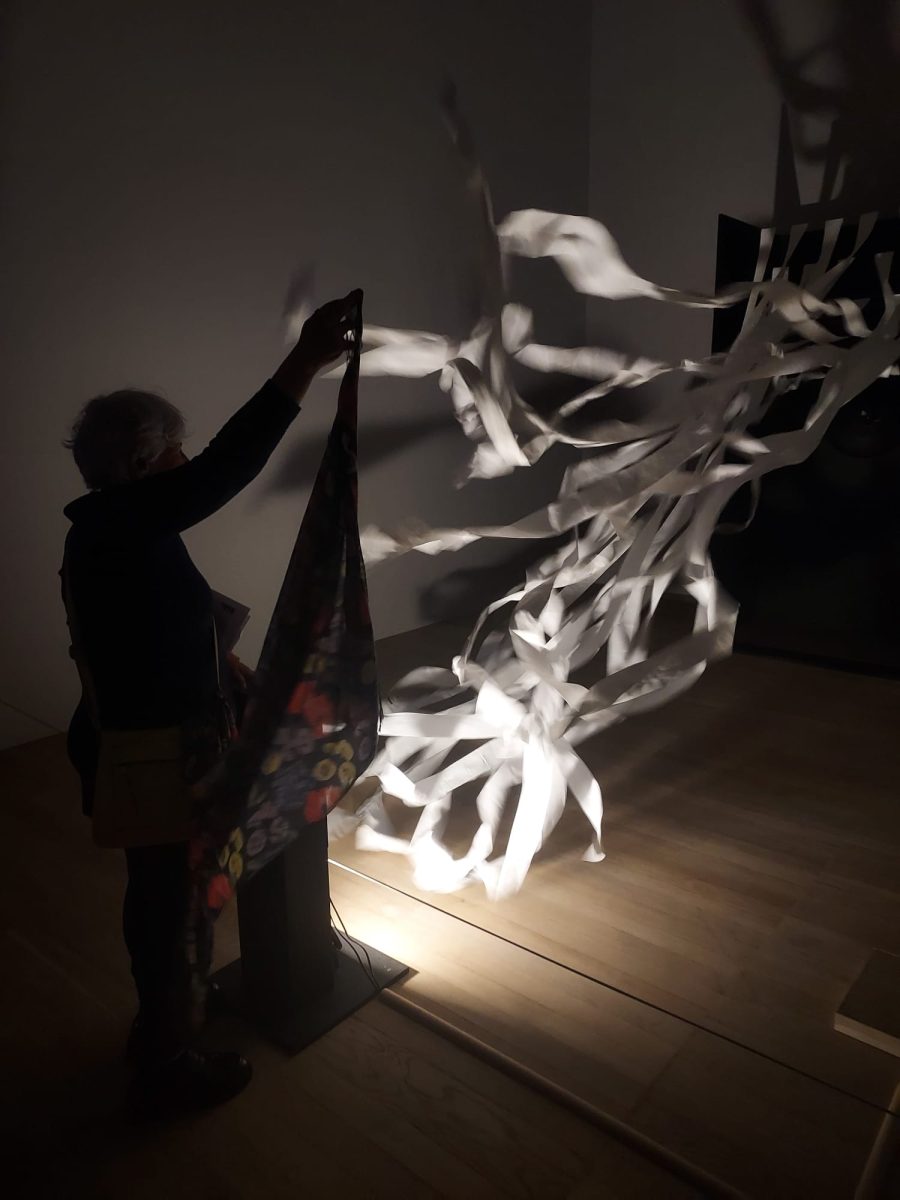
You can see above how a vistor is interacting with the Ribbons in the Wind installation made up of a wind machine and long plastic ribbons. It had been very wet getting to the exhibition so the artwork was being used to dry a very wet scarf. A new image , a different artwork is constructed.
Even the set up of the show is arranged like a labyrinth, taking the viewer on a journey he/she has to negotiate rather than being presented with a conventional curated exhibition
The GRAV group set up A Day in the Street in Paris in 1966 and despite the police’s negative reaction people played with prismatic glasses, moving platforms or elaborate shoes. During the May events in 1968 Le Parc joined the famous Popular Workshop which produced the iconic posters in support of the struggles. He was expelled for 5 months from France. Later in 1970 he participated in conferences and has a show in Havana. He works in solidarity with Latin American radical movements and joins the antifascist painters collective in 1975. In the 1980s he is active in the Committee of World Artists Against Apartheid. Finally he returns to Argentina as the fascist dictatorship falls in 1984. Julio returns to Cuba to run workshops with the population in 1986.
Although he remained a socialist (and optimistic) till his end, a few weeks before the show opened the exhibition fails to fully express his politics apart from in the excellent short film that can be seen at the end of the show. A cabinet with material from the GRAV, photos and other documentation could have been included. Some of his radical statements could have been highlighted on the walls as we have seen in previous exhibitions. Talking with the assistant curator at the end of the press preview he agreed that it would have been good to have more of those materials but they were restricted by space. To be fair the catalogue does contain a lot of this material. Unfortunately for someone who misses the film or does not buy the catalogue the relationship between his art and politics is diluted.
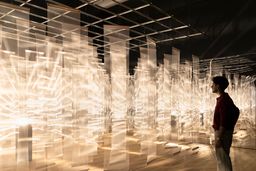
Inspired by artists like Tinguely who pioneered hanging mobiles that moved Le Parc incorporates the movement of light, colour and objects in his work. In the first darkened rooms of the show you are mesmerised by the movement of light shapes. There is one called continual Light Mobile(63 to 2024) that works like an aquarium with ever changing fish like shapes moving back and forth, right and left. Another called Vibrating Light (above) is in a large space and creates an infinity effect. The viewers’ movements also affect how the artwork changes as the air is displaced. He wanted to set up a process where ‘several more or less complex elements’ would interact in a way that was not controlled by the ‘hand of the artist or the expert’ (ibid p 69).
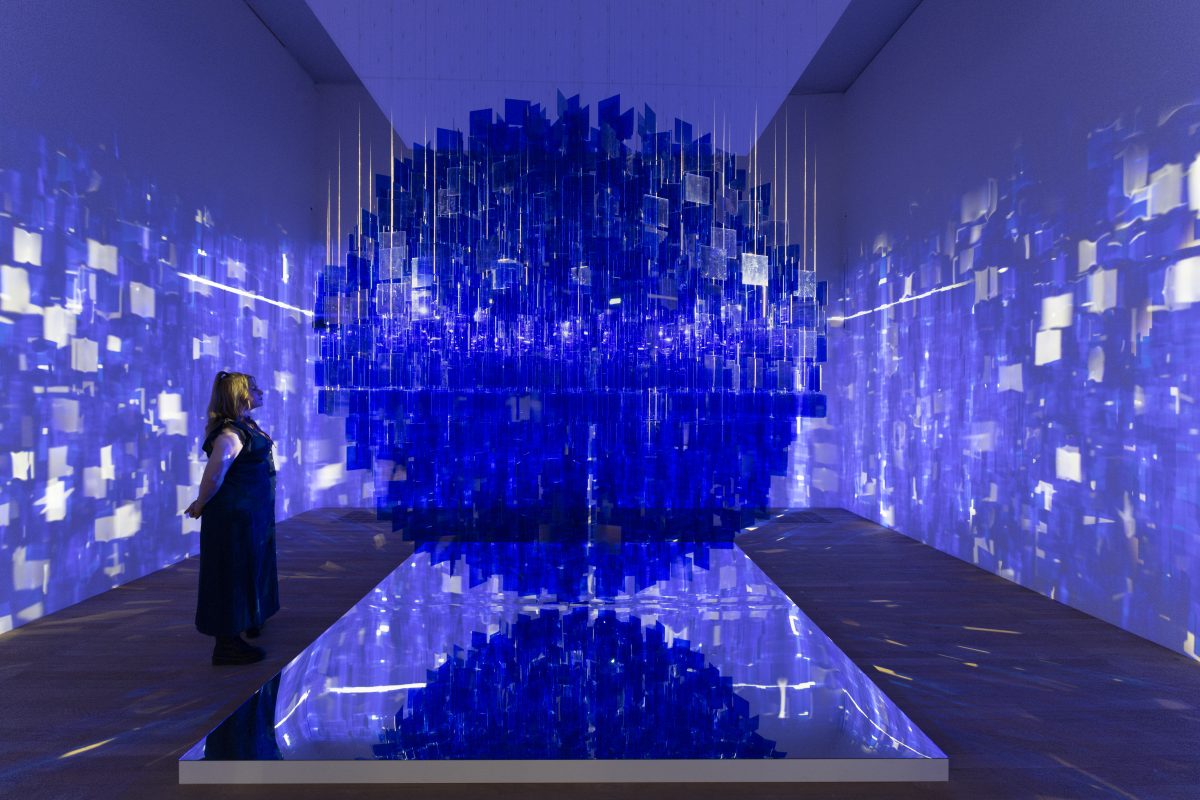
The construction feels digital but most of his art was done pre-digital but with ingenious use of basic lights and mechanisms. He produces mesmerising installations in which the viewer is immersed in light, colour and movement.
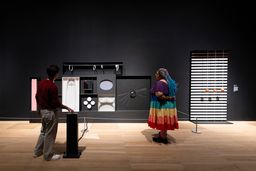
Going through the show you realise that Julio did not just want individual participation but a social one – groups of people can interact together with an artwork. The work itself changes every day with the involvement of a different public. Age also evaporates as children and adults can play together with a work. The Games Room section (see below) epitomises that. You are invited to push buttons, turn wheels or even help make a face. The latter was a bit like those toys you got that could turn a potato into a wierd or funny character. There is a playful aspect to his art that is very appealing. It is a bit like those fairground attractions that distort how you look. His art incorporates such popular culture rather than looking down on it from some artistic exclusivity
A socialist vision of art does not deny artistic genius, technique or brilliance but we want art to be totally democratised and for as many people as possible to make or at least involve themselves in the process of art. Art opens up the imagination. We cannot create a better, more beautiful world without imagining something quite different to the spectacle of the commodity that we currently endure. Part of the battle to convince people to ditch this system is to facilitate events and processes where art can lead us to question our imposed reality.
The sort of art Le Parc creates is not organised like most of the advertising images or films we consume which are to encourage us to consume ever more commodities. Many of these images promote an illusion of happiness and pleasure conditional on consuming the right phone, car or holiday. The majority are excluded due to lack of money but like the gambling ads the system continually reproduces a false, mythical link between our current situation and dreams of luxury.
Le Parc invites us to reflect on the beauty of light, colour and movement for their own sake and to imagine another world. Our playful interaction with his work takes us temporarily outside the oppressive framework of the commodity. It is the anti-scrolling environment. We slow down, take a breath and savour the imagery he offers us a seat in. We can look again with the open eyes of a child.
Destablilising the perception of the viewer was a key idea for Le Parc and the GRAV team:
‘..instability also represents a world in transformation, driven by the need for changes in the system of life for a better world. This notion is the opposite of conservatism, stability and permanence.’ (ibid p 99)
In the last room you can read the wonderful poem that he wrote a few years before his death and which he insisted should end the show. It is called Before.. and it is beautiful reflection of his fading health and impending death. It laments all the beautiful often contradictory parts of life that he will be leaving:
‘Before everything becomes a dark memory without memory
Before my hand can no longer hold a pencil (…)
Before I stop dreaming of you dreaming of me
Before you dance all alone
Before my mouth smells of fish (…)
Before my head bends towards the ground and forgets the sky
Before your body passes me by without seeing me (…)
Before i left the sound of the foul cannons fade in my head
Before I mistake the massacres of warmongers for target practice (…)
Before the mockingbird no longer sings of the Commune (…
Before Liberte Egalite Fraternite is replaced (…)
Close my eyes with your gaze alone
But
If by chance, my love, you notice my right hand searching for a pencil to make a drawing…
Then give me one last chance’
The whole magnificent poem is worth reading. His son spoke at the preview saying he was involved in the exhibition practically right to the end. He died a few weeks before it opened. Rest in Power Julio. Thank you for your art.
The exhibition, Light, Colour, Action is on until the 27th May 2027 at the Tate Modern in London