

In the late afternoon of 21 May, the Equality and Human Rights’ Commission (EHRC) issued an updated Code of Practice. The new code reinforces the Supreme Court’s judgment in For Women Scotland v The Scottish Ministers in April 2025, which defined sex for the purposes of the Equalities Act as “biological sex”.
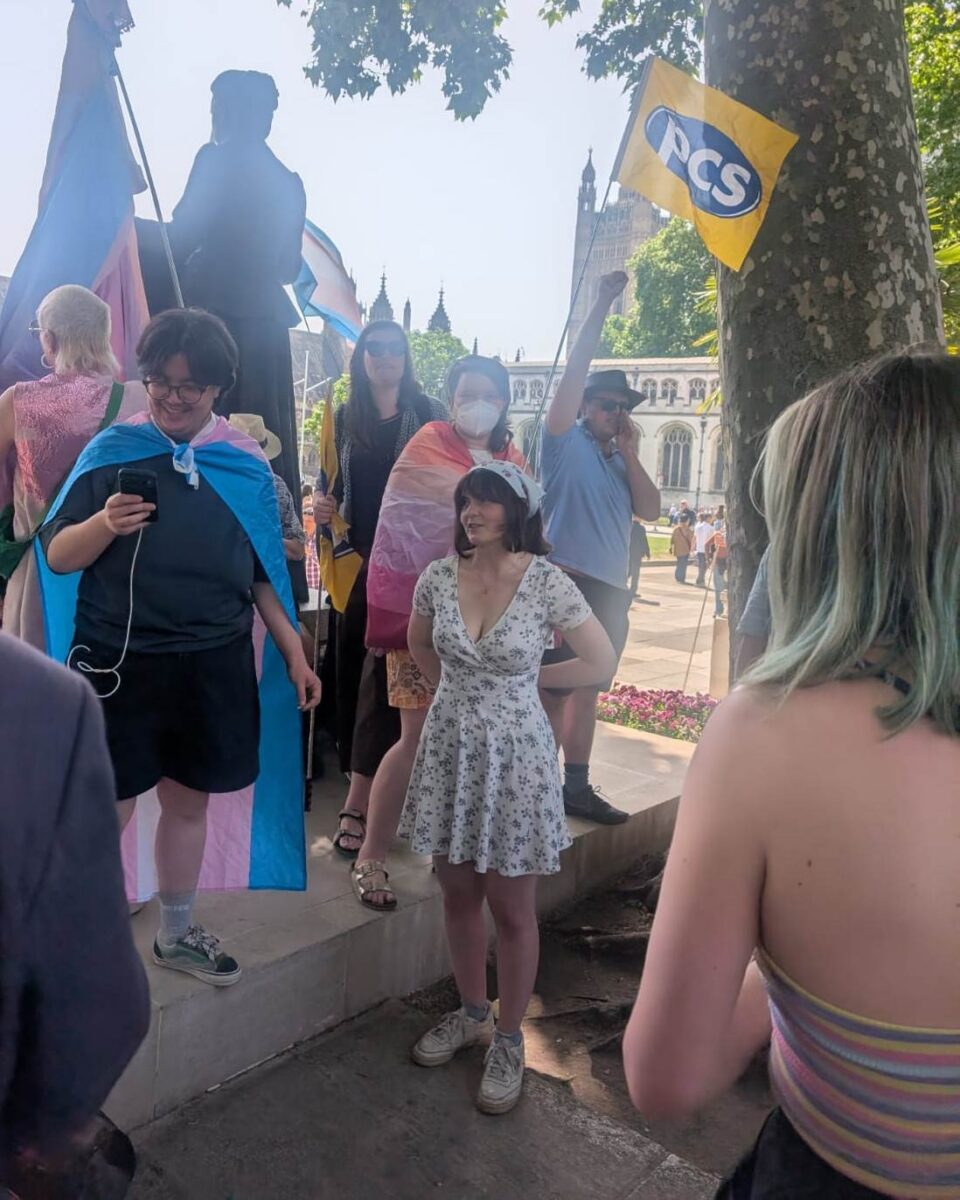
Within hours of the new code being laid before Parliament, plans were underway to hold protests across the country. ACR members initiated talks with organisations and networks within the community, and formed the organising group for the London protest on Saturday 23 May. The demonstration attracted over 200 people with less than 12 hours’ notice.
The protest was organised by a coalition of activists, allies and trade unionists, and was attended by people from across different campaigns and communities. There was a prominent trade union presence, in particular the Trade Unions Fighting the Far Right (TUFF) network, highlighting that one of the key battlegrounds for this guidance will be our workplaces. Many of the speakers referenced the need to unite struggles.
Spontaneous
The demonstration was a static protest with organisers inviting attendees to speak to the crowd in an open mic format. The spontaneous nature of the protest incapsulated the feeling of urgency and allowed a range of different people, trans and cis alike, to speak from the heart with hope, rage and resistance.
An independent trade unionist said, “we cannot wait for the law to change” and emphasised that trans people are also workers and renters – and that the fight must be fought in trade and renters’ unions and community organisations. Their words resonated with the crowd and underline that we must identify the points of leverage that we control. If our workplaces impose transphobic policies, we must withhold our labour. If our community centres don’t provide trans inclusive toilets, we should picket them.
Building on the previous speaker’s call to unite and build hope in our communities, ACR member Echo Fortune spoke about the role of hope as not just a human emotion but as foundational to human consciousness itself. “We think in terms of the future. We build the future.” If we are unable to see a future, we will only see despair.
Caroline Litman, former NHS psychiatrist and activist said, “the other big fight we have is cis complacency” and spoke of the importance of proper allyship, showing up for the trans community every day. Litman spoke as not just an activist but a parent to a trans daughter who sadly took her life in 2022. Her voice was a vital one needed to highlight the reality of the high risk of suicide amongst young trans people that the 2024 Cass review wilfully ignores.
Other parents of trans children also spoke to this point. Activist and ACR member Roland Rance said of his daughter who also sadly took her life in 2023, “Thalia was badly let down by the education and health services – and now they are proposing legislation to make life even harder for young trans people…Thalia was a living embodiment of the intersectionality and connection between struggles… And, as we stand here on a record hot day for May, let’s remember that she was also a campaigner for climate justice and against environmental devastation. In her memory, I will continue to fight for these causes”
Trade unionist Simon Hannah spoke about the need to build the broadest possible struggle in the fight for bodily autonomy which impacts every single human being. It is already common knowledge that notable anti-trans influencers, like Posie Parker, receive funding from anti-abortion organisations, and that the gender critical movement aligns itself with attacks on bodily autonomy that go beyond trans people.
Author and journalist Juliet Jacques, spoke of the fight within the press to take trans rights seriously and for the need to continue to create art and joy even in struggle. Peter Raistrick from the Musicians’ Union likewise celebrated the incredible music and work produced by trans artists. A world that is open to fluid gender roles and interpretations is a creative and generative world. It is a world of possibility. It is important that in the darkness of struggle we hold onto that fact. As Emma Goldman said, “if I can’t dance, I don’t want to be part of your revolution”.
Thin end of wedge
As the EHRC has shown, we cannot trust our institutions to protect us. Trans rights are the thin end of the wedge in the current culture wars, with changing understandings of gender becoming the scape goat for many of the ills of late-stage capitalism. Where trans rights are under attack today, tomorrow it will be the rights of the rest of the queer community, the rights of women, the rights of disabled people and the rights of migrants.
If the majority of people stand by and allow trans rights to be stripped away, we are paving the road to a far-right government taking power. Far right ideology, although posed as looking out for the people, is concerned only with protecting the status quo of capitalist production and profit. Rigid gender roles ensure the continuation of capitalist and patriarchal dominance, through strict divisions of labour. Trans liberation is a direct attack on that fundamental building block of capitalism.
By changing just one definition in the Equality Act – “sex” – the Supreme Court and now Parliament are shutting trans people out of all public life. But this is nothing new. As we have already seen, disabled people have been and continue to be shut out of public life through brutal cuts to an already underfunded welfare budget and cruel adjustments to PIP assessments.
When we rely on civil rights and protections from benevolent ministers or charitable millionaires, out to make a profit, we can see how easily they can be taken away. We must fight for our liberation in our communities and out on the streets.