

The BBC met the protest with even more silence. The BBC is not alone in totally ignoring the attempt to liquidate Rojava. Apart from a few articles in the Guardian and a brief item on Channel 4 News the mainstream media has hardly gone out of its way to report on this genocidal onslaught against the Kurdish population.
So, what is Rojava and why does it matter? Rojava, sometimes referred to as the Democratic Autonomous Administration of North and Esat Syria (DAANES) arose out of the 2011 uprising against Syrian President Bashar al-Assad’s brutally repressive regime and the war fought by Kurdish forces against ISIS.
While Assad was able to defeat the Syrian opposition and cling onto power until December 2024, with considerable Russian and Iranian help, Kurdish military units (organized in the Syrian Democratic Forces (SDF) played a major role in the defeat of ISIS. As a result, they were able to establish Rojava as a significant base containing nearly a third of the Syrian state, able to operate largely independent of the Assad regime.
During the war against ISIS, the SDF received military aid from the United States. After the victory over ISIS, the SDF was allowed to remain in charge of the areas it controlled and was also given responsibility for the prisons and camps holding male ISIS fighters and the women who actively supported ISIS, along with their children.
But Rojava was more than just an area of Syria. It was an attempt to put into practice the ideas of Democratic Confederalism espoused by the best-known Kurdish figure Abdullah Ӧcalan. Ӧcalan, former leader of the Kurdistan Workers’ Party (PKK), has been in jail in Turkey since 1999.
The PKK originally fought to create a Kurdish state independent of Turkey (and a state that might eventually unite the Kurds of Iran, Iraq, Syria, Armenia and Turkey). Ocalan and the PKK gradually abandoned the idea of a nation state and instead argued for autonomy and self-administration at a local level. This is precisely what the SDF created in Rojava.
At the heart of the Democratic Confederalism experiment was an attempt to create a society in which people of different national and religious backgrounds could live together in harmony. The most striking aspect of Rojava is the role of women. Rojava is not just the only place in the Middle East in which women have equal status with men, it is one of the few places in the world.
Women play a role at every level of Rojava society. The Women’s Protection Units (YPJ) are an integral partof the Kurdish armed forces and are playing a central role in defending Rojava from Syrian Army, Turkish backed militia and ISIS. The women of Rojava are an inspiration for us all but, as Natasha Walter wrote in The Guardian on 21st January (in one of the very few articles the mainstream media has bothered to publish) The revolutionary women of Rojava are in grave danger. That has consequences for us all.
Curent conflict
The current conflict with the Syrian Transitional Government (STG) began because of the refusal of the STG to accept the absorption of the SDF military units into the Syrian army. The STG (the central leadership of which consists largely of former supporters of Al-Qaida) insisted Kurds would only be accepted into the military on an individual basis. Not surprisingly, given that the STG has already carried out large scale murders of the Alawite and Druze communities in the short time it has been in power since the overthrow of Assad, Kurdish forces insisted on their units remaining intact.
The STG insist on a single unitary state while the SDF continue to defend autonomy. As a result, the STG launched attacks on 2 Kurdish neighbourhoods of Syria’s second city Aleppo. The Kurds were a minority in the city and were forced to flee. One of the consequences of the attack on Aleppo is that some of the Arab tribes who were previously aligned with the Rojava government have broken from them and are now involved in attacking Kurdish areas.
Some of the prisons holding ISIS fighters have been attacked and ISIS members allowed to escape. The US has airlifted some ISIS prisoners to Iraq but there is a real danger that many more ISIS fighters will be freed by STG allied groups and that these fighters will attempt to exact revenge on the Kurds who held them prisoner after the defeat of the ISIS Caliphate.
Trump, of course, has no interest in defending Rojava. Its anarchistic, libertarian and egalitarian ideals are anathema to the US President. The Kurds are no longer any use to the USA so they can be abandoned once more – as they have been many times in the past. Their only use would be if Trump’s envoy Tom Barrack (another billionaire, surprise, surprise) is able to cobble together a deal which doesn’t lead to the total destruction of the Kurds of Rojava. Trump can then claim to have ended yet another war.
It is very difficult to keep track of events in Syria, not least because the media consider it of no importance, certainly not compared to Greenland, Iran or Venezuela. Ceasefires are announced and almost immediately broken. Ahmed al-Sharaa (de facto leader of the STG) and President Erdogan of Turkey may or may not have consciously decided to use Donald Trump’s threats to seize Greenland as a smokescreen to hide their war on Rojava, but it certainly helped them.
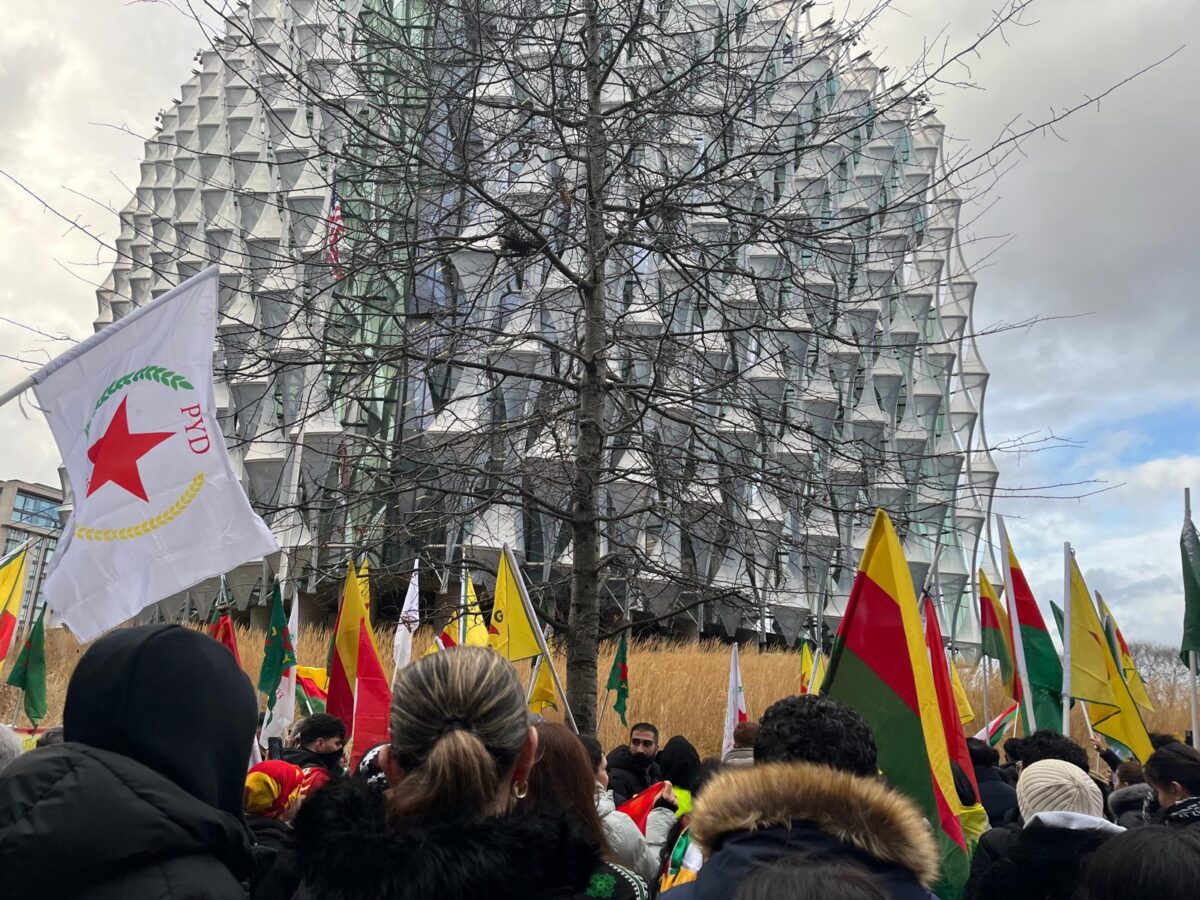
There have been major demonstrations throughout Britain in support of Rojava: Cardiff, Edinburgh, Glasgow, Bath, Bristol, Exeter, London, Newcastle, Sheffield, Manchester and Salford are just a few of the towns and cities that have seen support for the Kurds of Rojava. Demonstrations have also taken place throughout Europe, including in Antwerp where 6 people were stabbed by Islamists or possibly supporters of the Grey Wolves, a Turkish neo-Nazi organization.
The People’s Caravan is being organized from Cologne, Zurich and other places hoping to reach Rojava. Their aim is to get a large number of foreign journalists into Kurdistan to report from there (though I suspect Turkish and Syrian authorities will follow Israel’s example in Gaza by banning journalists). Kurds from Iraq, Iran and Turkey are trying to make their way to Rojava to defend the revolution.
Neglected by the left
In Britain the issue does not appear to have made much impression on the left. Sarah Glyn, a longstanding activist in support of the Kurds has published a piece in Bella Caledonia, a reposting of an article previously published by Green Left in Australia. But I can’t find anything in Socialist Worker or The Socialist on the struggle to defend Rojava. But at least they are simply saying nothing.
Sadly, there have been comments on social media that the Kurds deserve whatever happens to them because of their alliance with the USA in and after the fight to defeat ISIS. Or because they helped overthrow the Assad government which some on the left, despite all the revelations about the brutality of that monstrous regime still try to claim that Assad was an anti-imperialist fighter.
The SDF were perhaps naïve in their dealings with the US and didn’t prepare for when relations would change. Rojava was not a socialist paradise; it had faults. Not everything worked the way that Ocalan envisaged in his writings. There were some conflicts between Arabs and Kurds and Assyrians, Yazidis, Alawites, Druze and the Kurdish leadership of Rojava. These conflicts were not always resolved in the best ways.
But despite its weaknesses, Rojava remains an inspiration for socialists, in particular its support for equality and the liberation of women. We owe it to these brave fighters to stand with them against Turkish and Syrian aggression and indifference from the USA, Britain and imperialism as a whole.
So refreshing to finally read a good and nuanced article on Kurdistan, which the left has largely remained silent about, or given a very superficial and inaccurate readings of. Thank you!