


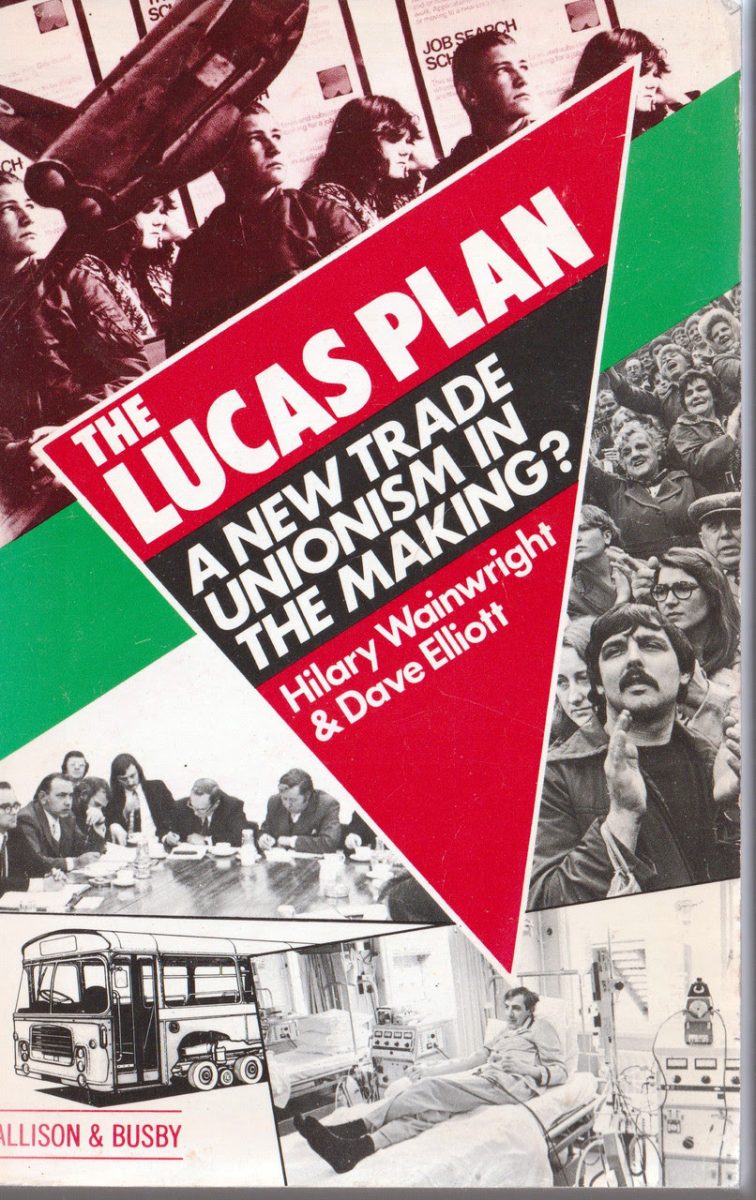
This year is the 50th anniversary of the Lucas Plan. Faced with mass redundancies workers at Lucas Aerospace devised a programme that was not only designed to save jobs and working conditions but also challenged the whole basis of the manufacture of munitions and aerospace components. Against military contracts, the Combine Shop Stewards Committee put forward over 50 pages of submissions proposing the replacement of socially dangerous products with socially useful ones.
With workers spread out over 17 different sites involving 12 different manual and ‘staff’ trade unions, it was initially difficult to get organised in a coherent and centralised way. To combat this problem, shop stewards from all the separate sites were brought together to represent the entire workforce. The Combine was organised democratically allowing each trade union autonomy and any recommendations reached by the Combine were relayed back to each site for consideration. To add to this there was the constant sharing of information via telephone communications.
Besides devising the plan, the Combine was effective in preventing management from playing one site off against another and enabled craft unions to negotiate from a position of strength including improving workers’ pensions.
The Combine’s Alternative Economic Plan chimed at the time with Labour’s Alternative Economic Strategy designed to shift the balance of power away from employers to greater workers’ control in order to combat the growing economic crisis. Ultimately Labour treacherously rejected this plan in favour of demands for public spending cuts and privatisation to secure a loan from the International Monetary Fund.
The Plan detailed over 150 designs for alternative products including wind turbines, hybrid cars, heat pumps, house insulation and solar cell research with full market analyses, economic arguments and training programmes in place. Besides the introduction of green technology there were also proposals to manufacture kidney dialysis machines, artificial limb controls and safe oceanic and braking systems.
Why it was scuppered
Lucas Aerospace management were hostile to the plan right from the outset and refused to meet with the Combine. They pulled the one about the Combine being outside established collective bargaining structures and not being a legal entity.
They argued that alternative products would be commercially unviable and incompatible with the market-driven profitability of their core manufacturing range despite the Plan’s detailed proposals. They also felt the plan undermined their managerial prerogative and viewed the grassroots initiative as an unacceptable challenge to their absolute right to control production.
Resistance
Left Labour MP Tony Benn, as Secretary of State for Industry in Harold Wilson’s government had encouraged workers to draw up a plan as far back as November 1974. Thirty five combine delegates had lobbied him to include Lucas Aerospace in the nationalisation of the aerospace industry. Benn argued he did not have the power to do this but suggested they draw up an alternative plan instead.
Benn was removed from Industry to Energy in 1975 and his sucessor Eric Varley abandoned the proposal and James Callaghan’s government (Janaury 1976-May 1979) continued that disdain. The pressure from successive governments to force the company into negotiations was abandoned with the shift towards neoliberalism, privatisation and deregulation under Margaret Thatcher. She was totally opposed to state intervention and led the attack on trade union power.
The top tier trade union officials feared rank and file militancy that bypassed their control of accepted hierarchical channels. The union bureaucracy were locked into defensive wage and job retention bargaining against radical changes to the production process and worried that plans for alternative production would develop outside their control.
Looking forward
There have been many attempts at resurrecting interest and debate over the years around the need for a new Lucas Plan as well as similar developments in other countries. The developments at GKN in Florence, Italy, are the most important contemporary development but the LIP occupation in France for example has already celebrated its 50th anniversary
Given flooding destroying towns and villages, melting ice caps and the recent spate of heatwaves spreading widespread wildfires in France, Canada, Greece, Spain, Italy, the USA and increasingly Britain, the urgency of combating an impending climate apocalypse cannot be over emphasised.
Today besides the threat of mass redundancies through the introduction of robotics and AI and the chaos, disorder and danger of inter-Imperalist rivalries ramping up the arms race, including nuclear weapons, our opposition to arms manufacture and militarism will be steadfast.
But the villain of the piece to be challenged as the main driver of climate change is the drilling for oil and the production of fossil fuels. What is needed to take this into account is a new Lucas Plan using the original 1976 one as an inspiration. The original opposition from trade union bureaucrats to the plan and the present trade union leaderships’ hostility to radical change is almost a replication of the fear that a just transition is a threat to jobs.
The only solution to the conservative elements in the trade union bureaucratic leadership, apart from voting them out of office, is for workers to draw up a new plan that demonstrates clearly that not only is a just transition possible but is also an urgent necessity given the climate diaster that is now engulfing the planet. Turning swords into plough shares or oil into wind turbines and solar panels won’t be easy but we don’t have a choice. Our very survival as a species is at stake.
See: https://lucasplan.org.uk/story-of-the-lucas-plan
Register for Manchester conference here