

Entering the exhibition you feel like you are visiting a minimalist penthouse apartment or a laboratory. It is a spotless, white space with bright light pouring in from the big windows. The exhibits are not labelled which further produces this stark, clinical environment. There is no softness or much colour in these sculptures or installations. Metal or bronze dominates. This show is not meant to be an escape from the cold realities of our world. Hatoum, who helped design the show, wants you to focus.
Giacometti provides human figures but they are his trademark thin people squeezed tight by an alienated world. Figures are nearly completely absent from Hatoum’s work. Instead we see the barbaric structures and shapes that torture, destroy and annihilate human beings. Her work is intensely political as she references the Gazan or Lebanese horrors. Giacometti communicates a more implicit and existential crisis of our society.
Although it is a joint show Hatoum’s work dominates and she played an important role in curating it. Indeed, the exhibition as a whole has an impact more than the sum of its parts – the exhibits interact with each other to leave an overall impact.
You feel a bit unnerved and disturbed by it all, which is the point. We cannot just turn our gaze from the genocide and misery that accompanies the affluence of a global minority. Nor can we minimise the mental health crisis and generalised anxiety afflicting even those of us who have materially comfortable lives.

Even if you have never heard the name many people have seen Giacometti’s stick like sculptures. He was affected by the death toll of Second World War and especially the Hiroshima/Nagasaki devastation with its future threat to human survival. There was much philosophical and political debate about alienation and our very existence in this period. Giacometti saw sculpture as a ‘kind of contained violence, which touches me the most’
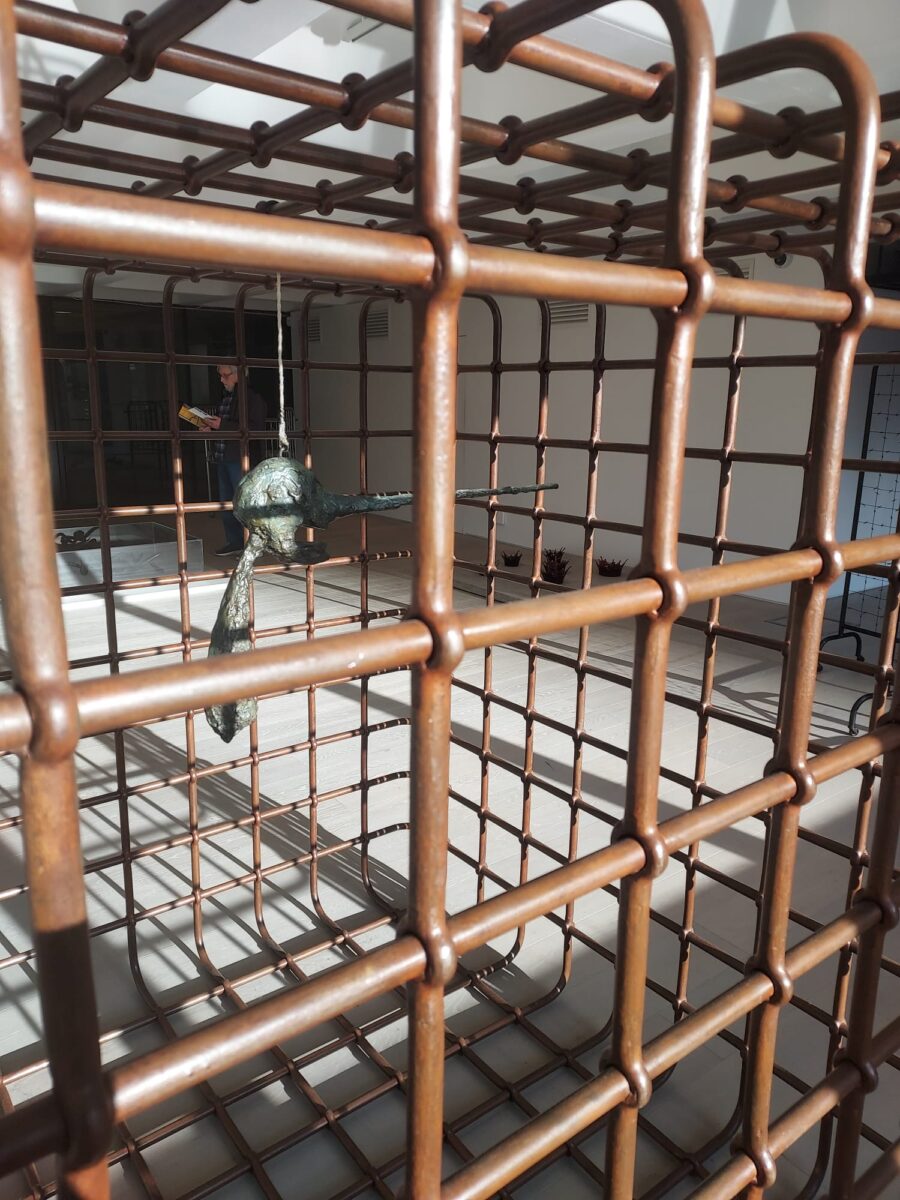
A link between Giacometti and Hatoum is the cage motif. He first used it in the 1930s to place his figures in ‘fixed dimensional relationships’ to their surrounding space. The work above, The Cage (1950-1) shows a head and a tree-like figure and the cage. Hatoum sees the cage as a way of visualising the physical and psychological limitations set by today’s social and political system. In this exhibition Hatoum got permission to dismantle one of Giacometti’s pieces and put it the cage she has produced. She took the Nose (1947) which represents the traumatic death experience witnessed by Giacometti. Physical features do get distorted in our last days, here the nose is extended beside hollowed out cheeks. Hatoum has put it inside her cage although the way she positions it suggests the possibility of escape.
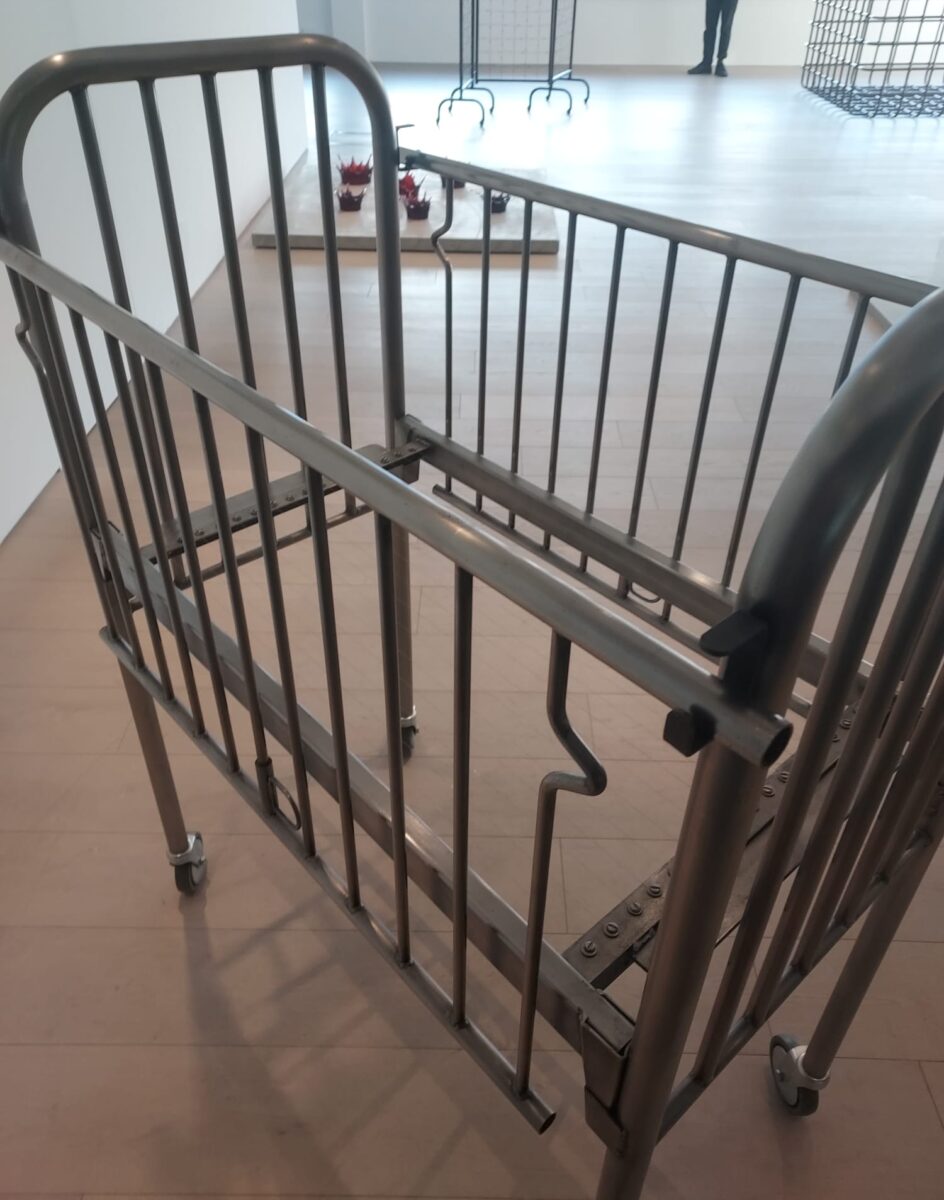
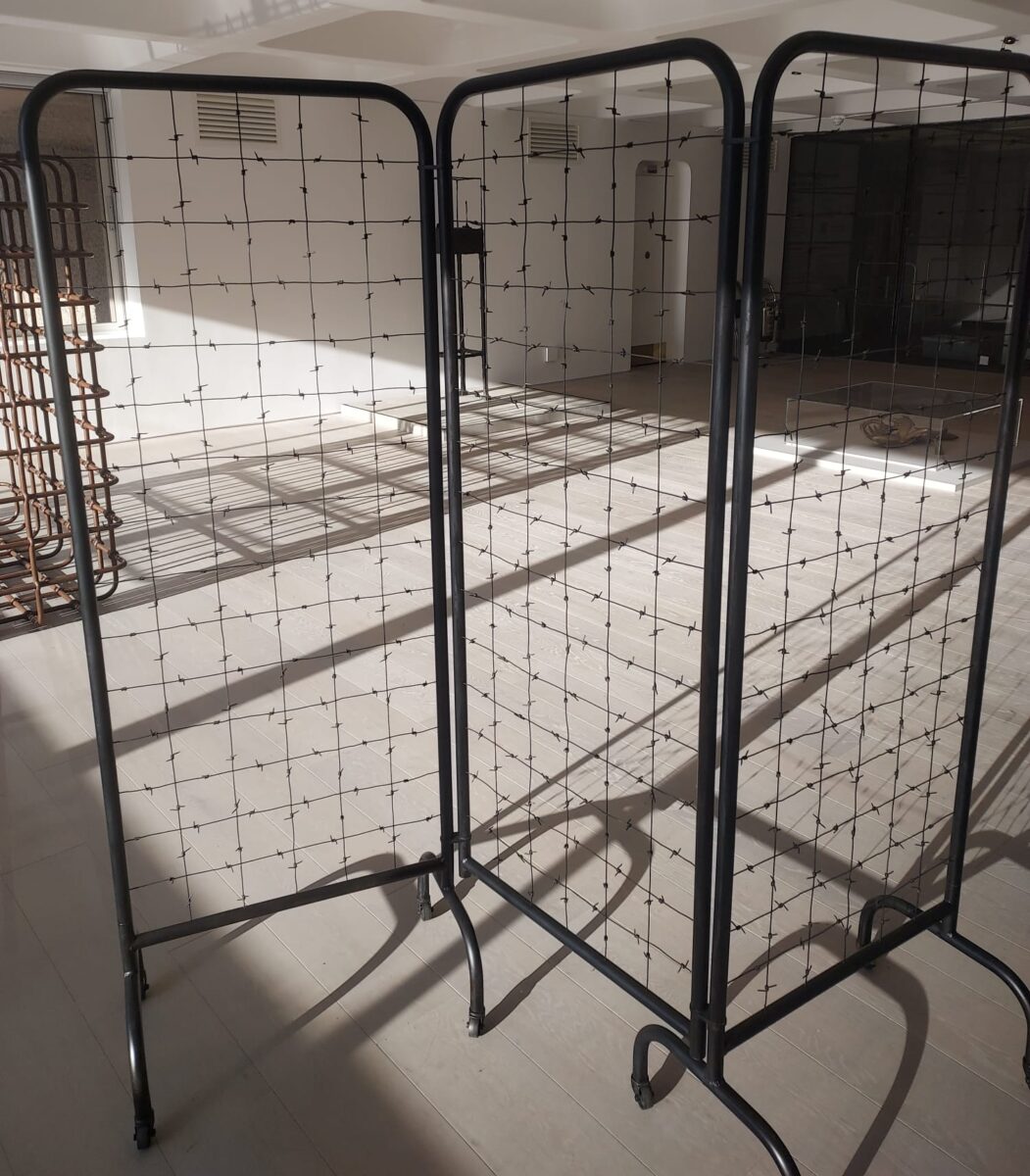
Two pieces that pull you right up are Hatoum’s Incommunicado (1993) and Divide (2025). The first is a metal baby’s cot but instead of a soft mattress you have a lethal cheese wire net. The Divide is a replica of a hospital screen but instead of a textile curtain insert you have barbed wire. We may think these are products of a crazed rather perverse imagination but then you think of the Israeli IDF offensive against hospitals and children. Her art communicates Gazan reality more directly and powerfully than the intermittent images lost in the everyday maelstrom of the mass media.
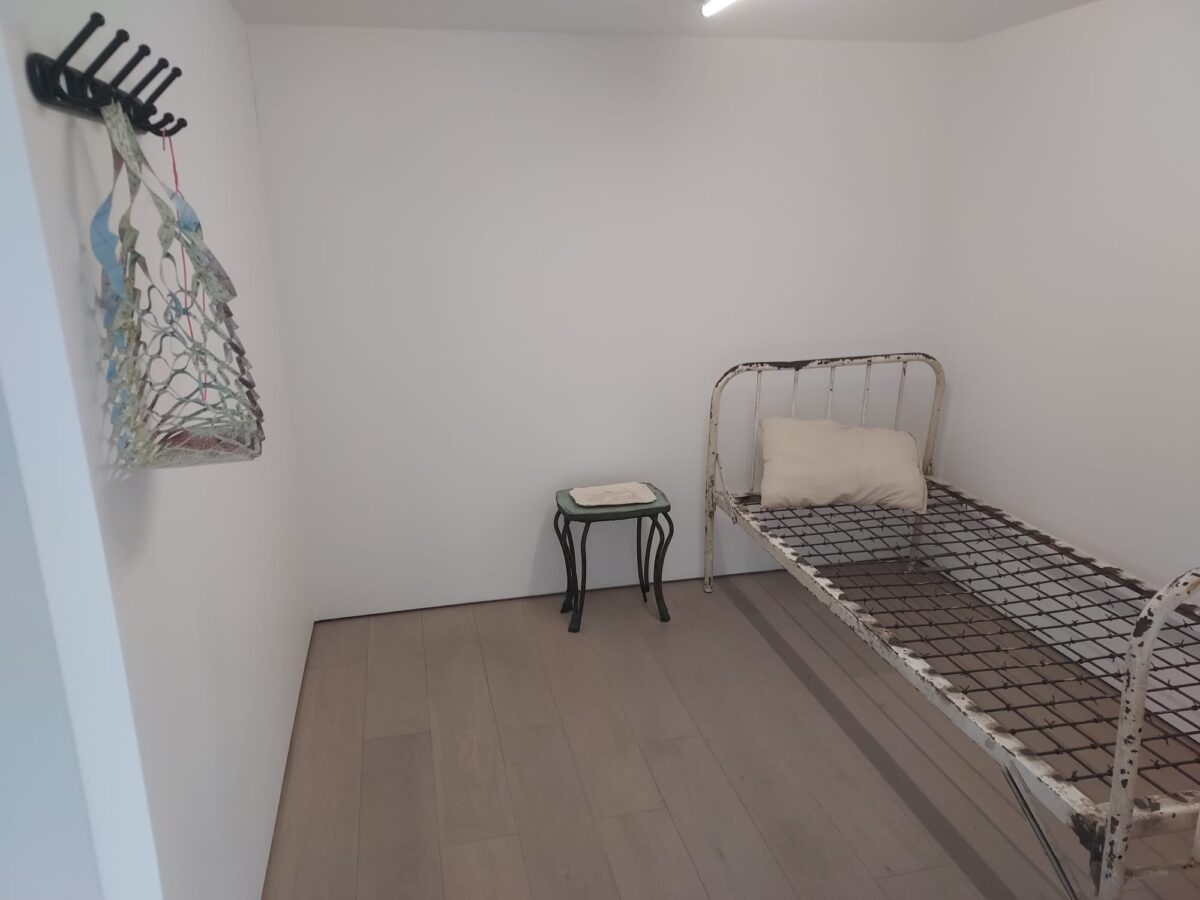
Hatoum’s most explicit reference to Palestine in the show is Interior Landscape (2008). It includes a steel bed, pillow, human hair, a table, cardboard tray, a cut up map, a metal rack and wire hanger. The historical map of Palestine emerges in various forms in the ‘room’ – in the shape of human hair on the pillow, in the distorted coat hanger, as a cut up historical map with the historical Arabic names and in the grease stains on the tray. Normally a bedroom like this should be a place of rest and comfort but this is a cell, cold and sterile with only the wisps of hair to suggest a ‘stolen’ humanity.
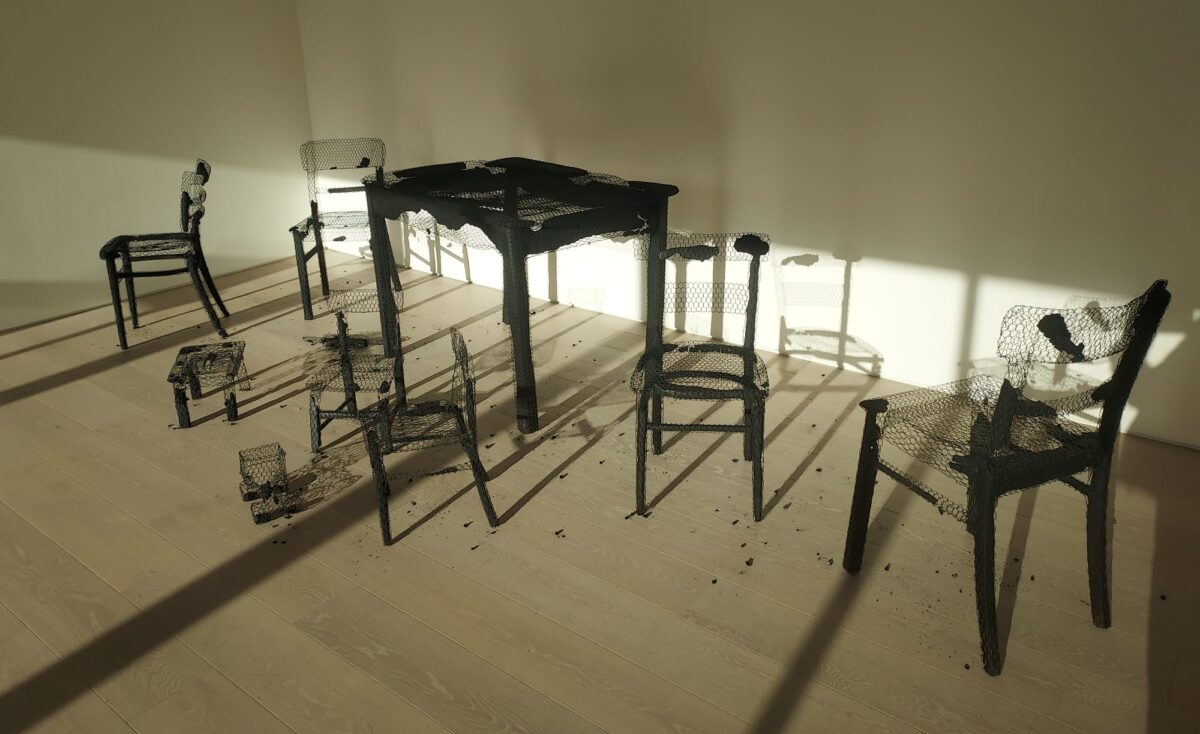
‘Remains of the Day’ (2016-18) is made of wire mesh and wood. Looking at this you know you are looking at a bombed out or burnt environment. This was made to represent the aftermath of war, violence or environmental catastrophes as was developed as part of her winning the tenth Hiroshima Art Prize.
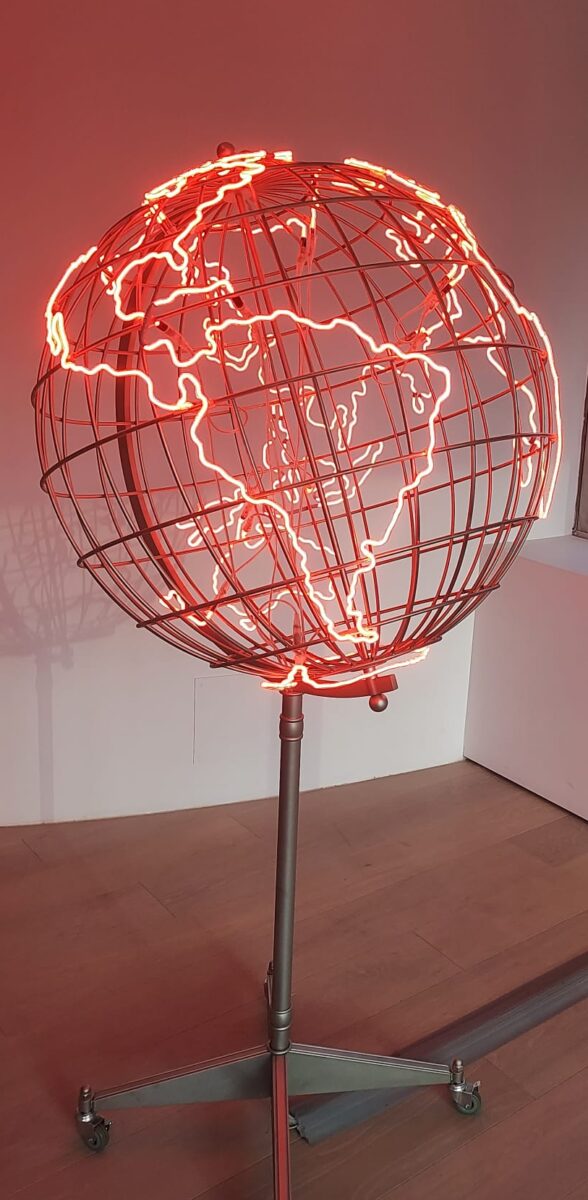
One of the smaller pieces in the show is Round and Round (2007) which is simply a circle of bronze toy soldiers with their guns pointing at the backs of the soldier in front – the relentless cycle of violence and war. A further powerful anti-war statement is the Hot Spot (2018), which is a steel cage like globe with continents outlined in red neon. She stated:
The idea behind this work was that ‘hot spots’ or spots of conflict these days are not longer limited to certain areas of disputed borders, but it feels like the whole world is caught up in conflict and unrest’. You can also interpret it as a globe on fire with global warming.
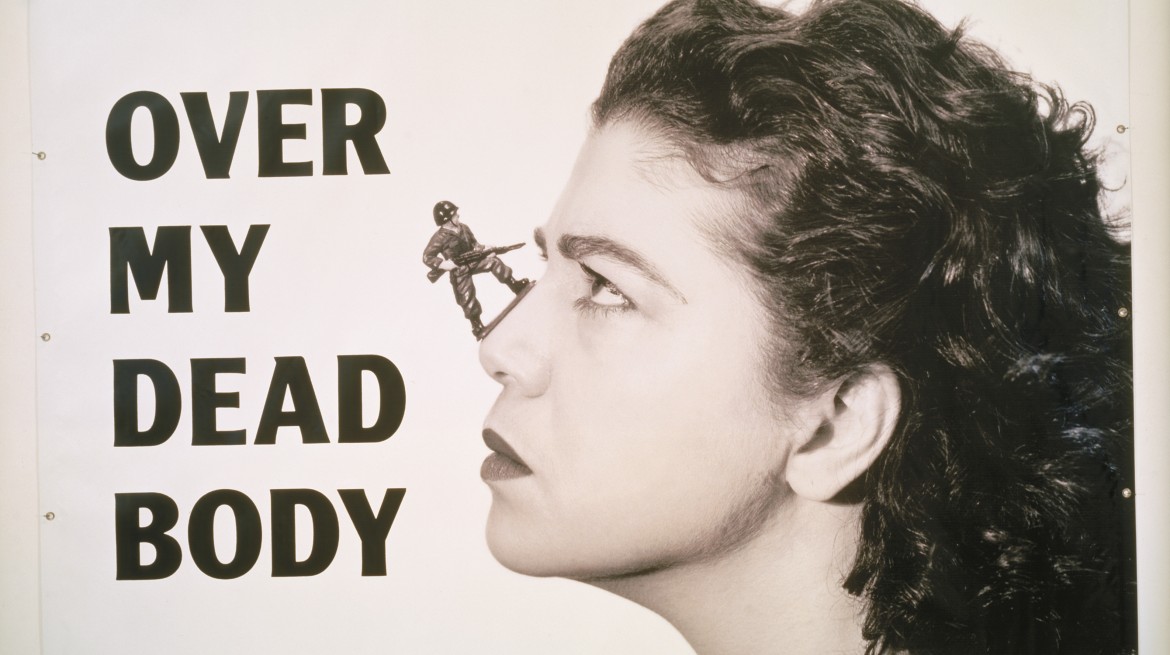
Hatoum is also a feminist and her poster, Over my Dead Body(1988), was used in advertising hoardings in Newcastle and other major towns as part of an anti-sexism campaign. She shows herself with a male toy figure on her nose: ‘I saw it as a humorous but also complex and contradictory image. I was playing with scale to reverse the power relationship by reducing the symbol of threatening masculinity to a small toy’.
The exhibition is well worth a visit and the Barbican Centre is considered a modernist ‘brutalist’ masterpiece. Unlike many of today’s shows it is not a marathon of exhibits or pictures which are often too much to take in during one visit.
All photos, except Over my Dead Body, are by Dave Kellaway. Acknowledgements also to the excellent exhibition brochure.
Art Book Review Books Capitalism China Climate Emergency Conservative Government Conservative Party COVID-19 EcoSocialism Elections Europe Fascism Film Film Review France Gaza Imperialism Israel Italy Keir Starmer Labour Party Long Read Marxism Marxist Theory Palestine pandemic Protest Russia Solidarity Statement Trade Unionism Ukraine United States of America War