

Anime is often snubbed as insufficiently artistic, which invites discussion beyond the scope of my review. This medium has value, operating in a similar sphere to the heightened, whimsical reality conjured by opera. It has appeal to queer and neurodiverse audiences as a form of storytelling that allows the direct processing of complex feelings without the trappings of the everyday.
Anime is a medium that responds to the traditions of Japanese manga in the wake of new cartoon technologies. It shares with manga an approach to structure and tropes, and with cartoons its pacing and commercialism. While it has many parallels, it is novel.

Frieren has a similar peripatetic setup to another anime I appreciate, MushiShi, i.e., the wandering sage alienated from society and fellowship. But its meditations on time, which is less a focus in MushiShi, make it special, whereas the former is more about mythmaking.
The Dungeons & Dragons-type world of this anime is much less foregrounded, but it is nonetheless brought to life with beautiful drawings that echo the ideas and stories. This is a fantasy role-playing game in which a group of players, under the guidance of a Dungeon Master, who controls the game, fight classic monsters in scripted adventures. In it, heroes face demonic adversaries for payment in an often cynical dynamic.
The elven protagonist is separated by her unique relationship to the passage of events, by her longevity in the companionship of lives that are shorter. This frames the events, allowing the frequent use of time skips to serve the narrative and character study at the heart of manga writer Kanehito Yamada and directors Keiichirō Saitō and Tomoya Kitagawa’s creation.
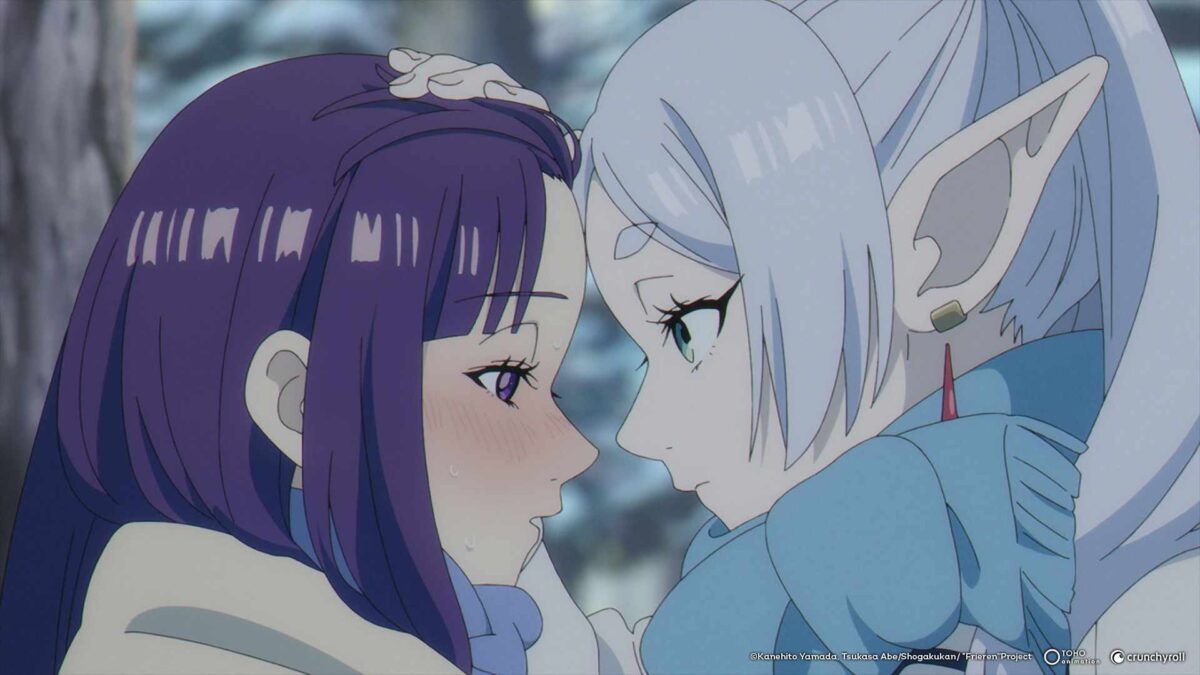
Grief is the show’s refrain. It drives Frieren‘s arcs of self-discovery; she seeks to comprehend death, and her knowledge becomes the same as her grasp of ethics, with the ostensible goal of accumulating magic, offering only a secondary pretext that nonetheless ties in. Magic is central to her relationship with her mentee Fern, whose humanity inspires a unique relationship to spellcraft.
Fern occupies a similar position to Ged in Ursula K. Le Guin’s The Wizard of Earthsea, but is decentred here as the viewer-proxy rather than the main character. Once introduced, she gives us our vantage point on the protagonist. We see her grow older and reflect on the meaning of age for her and those close to her.

The framing of time adds a wonderful queer element to the anime’s meditations on life. Frieren is notably queer, even explicitly, as she later describes all elves as aromantic if not asexual; she moves through the world at a pace mediated by how imposed otherness creates distance from the people with whom she interacts, augmented by her personality.
Clips taken out of context and used by fans to promote the anime tend to stress her rough edges, but the show itself is marked by gentleness and softness. Frieren wants relationships and strives to be kind. And the element of demons only really detracts from her development, offering a harshness askance with the core themes that nonetheless bring the whole into focus.
Nonetheless, the demons are not redundant, as the show wryly draws comparisons between their distance from humanity and her own. She mirrors gift-giving and head patting as forms of learned affection. The way she imitates humanity, seeking connection, is subtly contrasted with their imitation for manipulation and harm. And this adds a note of viewer discomfort, inviting uncomfortable questions about the nature of imitation, including humanity’s own.
Art Book Review Books Capitalism China Climate Emergency Conservative Government Conservative Party COVID-19 EcoSocialism Elections Europe Fascism Film Film Review France Gaza Imperialism Israel Italy Keir Starmer Labour Party Long Read Marxism Marxist Theory Palestine pandemic Protest Russia Solidarity Statement Trade Unionism Ukraine United States of America War