

According to its authors – who include the French economist Thomas Piketty, whose focus is mainly on income and wealth inequalities – The Global Justice Report: A Plan for Equality & Prosperity Within Planetary Boundaries reaches a simple but crucial conclusion: namely, that “it is possible to reconcile planetary habitability and high well-being for all.” As the authors of the report explain, the majority of mainstream debates surrounding such vital issues – including those put forward by the Intergovernmental Panel on Climate Change (IPCC) – tend to treat rapid decarbonisation of world energy systems, global wealth redistribution, fundamental reform of the existing international financial and economic order, and significant shifts in consumption patterns, as separate issues. Instead, Thomas Piketty et al. attempt, for the first time, “to propose a fully quantified plan” that will permit “an economically and ecologically consistent transition path” for achieving “human development and equality in planetary habitability” by 2100.
This is a huge – and, increasingly, vitally-important – agenda for all Earthlings, and thus demands serious consideration by all those seeking a more socially-just world, and a more ecologically-harmonious way of living in it. The Report is based on achieving change via three crucial pillars: fast decarbonisation of energy systems; a fundamental shift as regards ‘sufficiency’ and consumption patterns; and a “drastic reduction in income, wealth and power inequalities” between and within countries in order to finance these necessary changes.
Fig. 1 – The Global Justice Report, 2026
In a nutshell
This Report is both long (129 pages) and hugely ambitious – as befits the deepening polycrisis which humanity and the rest of the natural world are facing. And, as it should be, it is a huge read. The main arguments and pathways are as follows:
- Fast decarbonisation
The aim here is to reverse what UN General Secretary António Guterrez called, as recently as 2024, “a highway to climate hell and global destruction”, so that ‘global boiling’ can be limited to no more than 1.8oC by 2100. The big challenge here is that current trends regarding fossil fuel consumption and GHG emissions indicate that global boiling (deliberately adopting Guterres’ use of that term in 2023, and avoiding the Report’s use of the more-comforting term ‘warming’!) is likely to be over 4oC by 2100!
2. Sufficiency and consumption pattern
Here, the aim is to avoid climate catastrophe by ‘transforming’ what’s called “the economy”, via shorter working hours; a shift from more material-intensive manufacturing to sectors such as health, social care and education; and by major changes to food systems and land use to align global resource to within ecological boundaries on what’s correctly identified as “a finite planet.” Significantly, the Report doesn’t use the term ‘De-Growth’ – though it also doesn’t refer to the much more appealing – and accurate – term ‘Radical Abundance’.
3. Reduction of global inequalities
Here, the Report argues that to bring about the other changes, there will need to be a really significant increase in wealth for the bottom half of humanity – which currently owns around 2% of global wealth – to 30%. Such a wealth redistribution would require the wealth of the billionaire class to decrease from 6% to 0.05%. As a result, the average per capita gross monthly national income would rise to €5000 in all countries by 2100 – currently, the figures range from €290 in Sub-Saharan Africa to €4590 in North America. As part of the aim to achieve much greater equality, the Report emphasises the importance of achieving “full gender equality in labour hours and pay.”
A global ‘cunning plan’
One of the great strengths of this Report is that, as well as the rigorous and well-referenced written sections, it provides many tables, charts and figures that set out, quite clearly and logically, how their aims can be realistically achieved. For this alone, the authors deserve the thanks of all those wanting to see a socially-just and a ecologically-sustainable world. Over four chapters – along with an Introduction and a Conclusion – the Report sets out the current situation as regards the inequalities, unsustainability and mounting climate dangers; establishes the aims which need to be adopted globally; and maps how the changes needed to achieve global socio-economic equality and prosperity, within planetary boundaries, could be achieved.
However, in broad terms, much of what – and how – this Report argues in 2026 has already been done by earlier studies. Firstly, important work on some of these concerns had been carried out earlier by Johan Rockström and the Stockholm Resilience Centre. Having established the existence of nine ecological planetary boundaries, Rockström et al. noted in 2009 that three of those safe boundaries had already been crossed. By 2023, six had been crossed.
Furthermore, in 2012, Kate Raworth – in line with the new discipline of ecological economics which had begun to develop in the 1980s – crucially added ‘safe’ social and economic boundaries. These were then developed in her 2018 book, Doughnut Economics: Seven Ways to Think Like a 21st-Century Economist. Like the Report under discussion, she graphically illustrated such arguments via her doughnut image, and powerfully argued for the pressing need – and the steps required – to live within all such planetary boundaries.
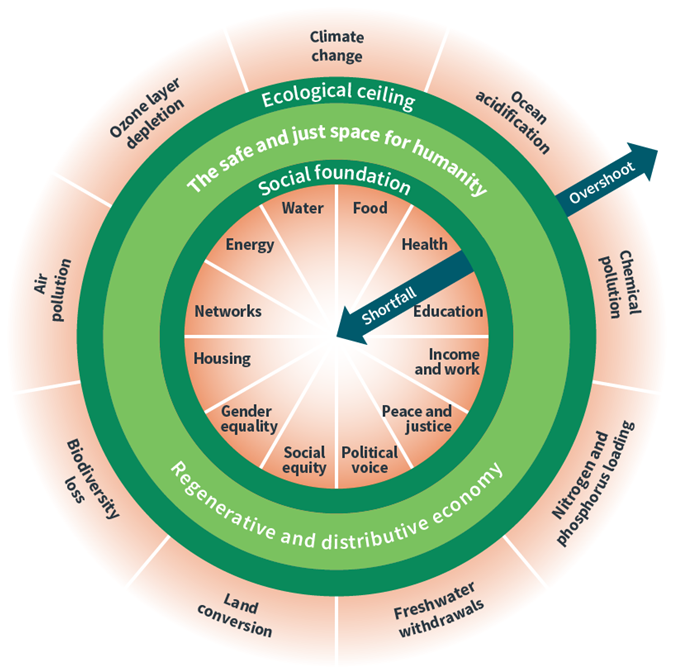
Fig. 2 – Kate Raworth’s planetary boundaries doughnut
Since then, Julia Steinberger, Professor of Ecological Economics at Lausanne, has further developed such arguments. In a podcast in April 2026 https://www.planetcritical.com/julia-steinberger/ she explained how “A flourishing human society doesn’t have to cost the earth. In fact, our wellbeing and Earth’s wellbeing hinge on the same thing: reducing inequality.” However, two years earlier – in ‘What we are up against’ https://daringindanger.substack.com/p/what-we-are-up-against – she went one crucial step further, by explicitly calling attention to just how the billionaire-elites use their economic and political power to resist the changes needed to ensure the wellbeing of humans and the Earth. One of Julia Steinberger’s conclusions in that article was that we need to turn anger and knowledge into revolution. One paragraph – which isn’t reflected in the Report – is worth quoting in full:
“The hour is late, both in terms of the triumph of neoliberal economics and its tag-along fascism, … The betrayal of the promise and potential of our societies is immense. But there are two emotions that can energise even the most depressed and defeated: anger & hope. There has never been more objective reason for anger, learning this new evidence about the destruction of our societies and our worlds. And there has never been more objective reason for hope, given the new possibilities for alternative energy production, away from fossil fuels, and sufficient and efficient ways of using it. For the first time perhaps ever, ecologically safe universal human prosperity is within reach. There is a lot to be angry about, and even more to fight for. Onwards”
Capitalism: the elephant in the room
It is that more realistic and combative approach suggested by Julia Steinberger – which rightly directly confronts the powerful economic and political vested interests which will have to be defeated if we are to achieve that “ecologically safe universal human prosperity” – which seems largely absent from the Report. To be fair, the authors of the Report make it clear that they don’t see their suggested pathways, by any means, as the end of the debate – instead, they see their Report as a clear, well-argued and well-supported “small contribution” to solving the huge and multiple challenges confronting us today. They also see it as aiding the global “broader collective movement” already underway especially in the Global South, but also in the Global North – such as the Progressive International. However, despite a significant number of movements within that broader alliance increasingly moving towards ecosocialist positions, the Report never uses the term ‘capitalist’ once.

Fig. 3 – Capitalism: the elephant in the Report
Yet, strangely – given that their proposals require significant, and relatively rapid, shifts in global economic and financial wealth, and in political power – the authors tend to talk about the ‘great transformation’ needed to successfully address those issues in what are general, even vague, terms. This perhaps has something to do with Piketty’s position as a social democrat who essentially believes that capitalism can be reformed. What is conspicuously absent is an explicit reference to the real class power that operates on both global and national levels. Although the authors, in the Conclusion, call for “A Global Citizen Movement for Social Justice”, there is no real attempt to consider whether, in fact, the minority billionaire class – approximately 0.001% of the world’s population – will agree to giving up any, never mind how much, of their current wealth and political power.
As has been established in many studies – including in George Monbiot and Peter Hutchinson’s The Invisible Doctrine: The Secret History of Neoliberalism (2024) – neoliberalism has effectively ‘hollowed-out’ democracy in even the most ‘developed’ countries. In virtually all countries today, the billionaire class effectively control state power. Successive COP ‘agreements’ have shown how that small class has repeatedly watered-down or even blocked attempts to significantly-reduce GHG emissions, or to compensate those countries in the Global South currently bearing the brunt of the ever-worsening Climate and Ecological Crisis which has been largely created in the Global North. Similarly, in country after country, governments attempting to significantly reduce income and wealth inequalities, and to introduce social welfare programmes, have been effectively undermined – if not overthrown. In fact, in many countries, that small class of billionaires has successfully pushed through policies designed precisely to reverse existing welfare services in country after country.
Ecosocialism – or capitalist barbarism
Whilst we should embrace the aims of the Report – and fight for the solutions the authors have so cogently advocated – in order to achieve important transitional reforms which will take us nearer to the socially-just and ecologically-sustainable future envisaged in the Report, campaigners will ultimately need to consider steps which take us beyond capitalism.
Because the world has not got into the dangerous and increasingly-unpleasant mess it’s got into because of the greed of a few billionaires. This has been a baked-in result of the capitalist system itself – as early as the 1860s, Karl Marx had commented on how the capitalist system – not individual capitalists – would create a fatal ‘metabolic rift’ between humans and the rest of the natural world.
This understanding was very much in evidence amongst those who attended the third Ecosocialism Conference https://anticapitalistresistance.org/ecosocialism-conference-2026-getting-organised-on-a-burning-planet/ on 30 May this year. The Conference was jointly organised by Anti-Capitalist Resistance https://anticapitalistresistance.org/ , the Ecosocialist Action Network https://ecosocialistaction.org/ and Greens Organise https://greensorganise.uk/ – and its theme was the burning (pun intended!) question of ‘Getting Organised on a Burning Planet’.
Ecosocialism isn’t a ‘new’ idea – it was there in the early work of Karl Marx and Friedrich Engels (as so ably demonstrated by John Bellamy Foster and Paul Burkett), and was known as Red-Green politics in the 1980s. And, if Your Party – and those new formations the Socialist Federation and the Connections Network which have recently emerged from the wreckage of the initial YP initiative – really want to become a mass radical party, fit for the 21st C, they will have to embrace ecosocialism, and put the Climate and Ecological Crisis at the centre of their politics. Because they are class issues.
As Michael Löwy said in 2015, in his Ecosocialism: A Radical Alternative to Capitalist Catastrophe:
“The central premise of ecosocialism, already suggested by the term itself, is that nonecological socialism is a dead end and a nonsocialist ecology cannot confront the present ecological crisis.”
This is precisely the direction that movements wanting to achieve the transformations so ably set out in the Report.