


The Film opens with a high tracking shot of a yellow Volkswagen Beetle travelling down a country road amid immense fields of sugar cane. Zoom in on the solo driver, who looks in his thirties. He pulls over to a one-shack petrol station.
He gets out, and the camera pans to see a pile covered with a piece of cardboard. As we come closer, we see an arm or a leg poking out. Swing around, and we see the sweaty station manager with a huge belly trundling out of an open shirt, asking the driver if he wants a fill-up. Then you see him running and screaming towards the body – a band of wild dogs had been attracted by the putrifying body.
He explains to the driver that the body had been there for three days. He was a thief killed by one of his employees, who had since run off. The police had been ‘too busy’ to deal with it. When the police arrive, instead of dealing with the body, one of them comes to the car and interrogates the driver.
He is looking for an infraction to solicit a bribe. He struggles but eventually finds the spare tyre is a little bare. Our driver has little cash, so he offers the officer a half-empty pack of cigarettes, which is reluctantly accepted.
The scene is shot slowly in the tropical heat, but like the best classic openings, it creates the mood, the feeling, and the elements of the story. Armando, our lead character, is introduced. Death, violence, corruption, and a breakdown of ethical order are in your face from the start. The film is worth seeing just for this opening.
Police as fascist goons
We jump to a harbourside room shortly after, where a giant shark is laid out on a table. Again, we move in closer and find a human leg poking out of its slit side. The police are there wanting to recover the body part.
A marine scientist is there, too, and insists on removing the leg so the police do not mess up the shark. The leg is slowly extracted. It has a ghastly, veiny purple appearance that makes you squirm in your seat.

Jump to another scene with plainclothes police who stop on a bridge. One cop gets out, opens the trunk. He shoots a couple of rounds into the back, making sure the victim is dead. He hauls out a body sack and heaves it over the edge. It is all performed matter-of-factly with the banality of everyday chatter. He could be delivering a parcel.
The police chief talks several times in the film of the rising death toll in the area during the carnival period – over a hundred. As the story unravels, you realise the police are ‘disappearing’ people. That is why they were ‘too busy’ to attend to the ordinary murder at the petrol station.
The normality of repression by the state and its irregular operatives during the Brazilian military dictatorship (1964-85) is brilliantly communicated. You do not need political speeches from right-wing or left-wing characters. This is the power of cinema in the hands of a great director.
Armando becomes a problem
The film delights in meandering through subplots, but the main narrative centres on Armando, who we see in his Beetle at the start. We discover why he is on the run to the north of Brazil, to Recife. He was the leader of a university research unit financed by public funds. His research includes developing an electric car prototype.
The unit receives an official visit from the director of Eletrobas, who brings his son. Without much ado, he says he wants to take over the unit because the research was a waste of public funds and would fit better within his operation.
Again, the director does not get into the details and the exact political connections, but it is clear that this boss has the dictatorship behind him and can do what he wants. During the dinner, he also makes sexist comments about Armando’s wife, who stands up and takes him on.
The director does not worry about detailing all the subsequent steps in the Eletrobas takeover. We just see Armando on the run. Later on, we see the boss setting up a hit squad to find and eliminate him.
Armando is taken in by a type of ‘freedom railroad’ who provide him with a hiding place in Recife and a new identity. His son is there, looked after by his father-in-law since his wife’s death. We never find out how the wife died. Perhaps eliminated by the boss she so disrespected. The director leaves gaps like this; the fascist past has its secrets.
The boy is obsessed with the film Jaws, which is heightened locally by the story of the shark and the human leg. These sub-stories enrich the simmering, predatory violence in the film. The director likes to throw in these arbitrary adjacent plot lines. The father-in-law runs a cinema which is showing a Jean Paul Belmondo film called Secret Agent.
Hence, the title, which leads you to expect a spy thriller! I suppose the director likes the unexpected, the misleading, and the disarming of his audience. The real world is not as neat and clear-cut as most movies present it.
A freedom railroad?
The ‘refugee community’ is run by an old woman, Sebastiana. This is her story, and the quote captures this strange mix of people:
I spent the war in Italy. I went to study music, then things kept gettin’ worse, and I just stayed. I couldn’t get back. There I was a communist, later I was an anarchist… or the other way ’round. I saw some things I’ll never forget, that I’ll carry with me to my grave. I also did three things that I won’t talk about, but I did’em. Time goes by, and I came back to Brazil and became a public servant in this fucking military government. Just sad, y’know? But life goes on, and I wanna say you guys have made me happy, just keep that in mind. This shit will pass, y’hear? A toast to everyone here, to my dear departed Andrea here, to my friend Geraldo – life’s got its bad stuff, but it’s got good too. To this woman whom I call Teresa Vitória, who’s going to Sweden with Antonio, to Marcelo who is Armando, to Claudia who’s Claudia and to Débora who is Débora, who I’m sure will grow up in a much better version of this country. A toast to Haroldo who’s not Haroldo!
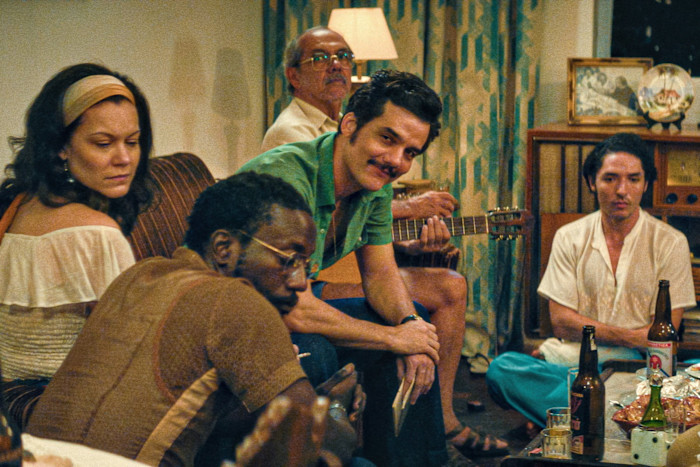
We are not talking about a conventional left-wing resistance set up, even if the people organising it are anti-fascist. Later, we discover it is financed by a dissident individual in the wealthier class.
If anything, the brutality of fascism is represented more effectively in the film because the protagonists are not the conventional characters within a left-wing network. Fascism devours anyone who resists. Thankfully, people also fight back as human beings without having worked out politics.
Armando does not threaten the military regime directly; he just came up against one of its powerful supporters. Perhaps his electric car research was a threat against fossil capital, but it is not evident from the film. He and his wife just did not give due “respect” to the mafia-style managers of the regime.
At one stage, there is even a little magical realism when we see the leg recovered from the shark launch attacks against the LGBT+ community in the local park. Fascism always targets those who are different from the defined norm.
Contested memory
The last quarter of the film runs like a thriller as the contract killers search for Armando, who has now taken the name Marcelo. The tension and violence are very well done, as we wonder whether they will eliminate him.
There are also flashforwards or scenes from the future that punctuate the film as we discover tapes of the interview between Armando and one of the organisers of the freedom railroad. Presumably, in recent times, during the historical research of the military dictatorship, these tapes have turned up.
A contemporary university researcher becomes emotionally connected to the story and seeks out Armando’s son. In Brazil, as in Chile or the Spanish state, there is always an ongoing struggle to rediscover and preserve an accurate history of what happened during the military dictatorships.
In today’s world, where might appears right, journalists and academics are again being witch-hunted by Trump and his allies; this story is hugely pertinent. This is what fascism looks like. Yesterday, Hegseth, the US Defence Secretary, gloried in the killing of Iranians. He sneers at the liberal values of democratic national building and the rules of engagement that once served as cover for US intervention in other countries.
Another Oscar nominee and favourite, One Battle after Another, also presents this creeping fascism. Anti-migrant repression is a key element, but some people, including Leonardo DiCaprio and Teyana Taylor’s characters, fight back.
Sean Penn, who plays the main ICE fascist, dedicates his life to an obsessive search for Caprio and his former comrades. It is a different type of movie – more like a Hollywood blockbuster but with some critical politics. Along with Sinners, the Black blues anti-racist vampire movie, we have three excellent anti-Trump contenders for the Oscar awards this year.
Secret Agent is directed by Mendonça Filho, a son of Recife, and the main actor, who won at Cannes, is Wagner Moura. It is currently screening in cinemas. For once, the length does not become tedious but absorbs you into the sweat, sounds, and salsa of 1970s Recife.
Art Book Review Books Capitalism China Climate Emergency Conservative Government Conservative Party COVID-19 EcoSocialism Elections Europe Fascism Film Film Review France Gaza History Imperialism Israel Italy Keir Starmer Labour Party Marxism Marxist Theory Palestine pandemic Protest Russia Solidarity Statement Trade Unionism Ukraine United States of America War
One comment