


Most people who think of the dot painters (pointillists) of the Neo-impressionist movement think of Seurat’s painting Bathers at Asnières. It is in the National Gallery and is one of the most reproduced pictures in the history of art. It conveys a hot day spent relaxing by the river and demonstrates how the pointillists transformed art. After scientific research into how colours interact, some painters began combining thousands of small dots rather than longer brushstrokes to create a new pictorial style.
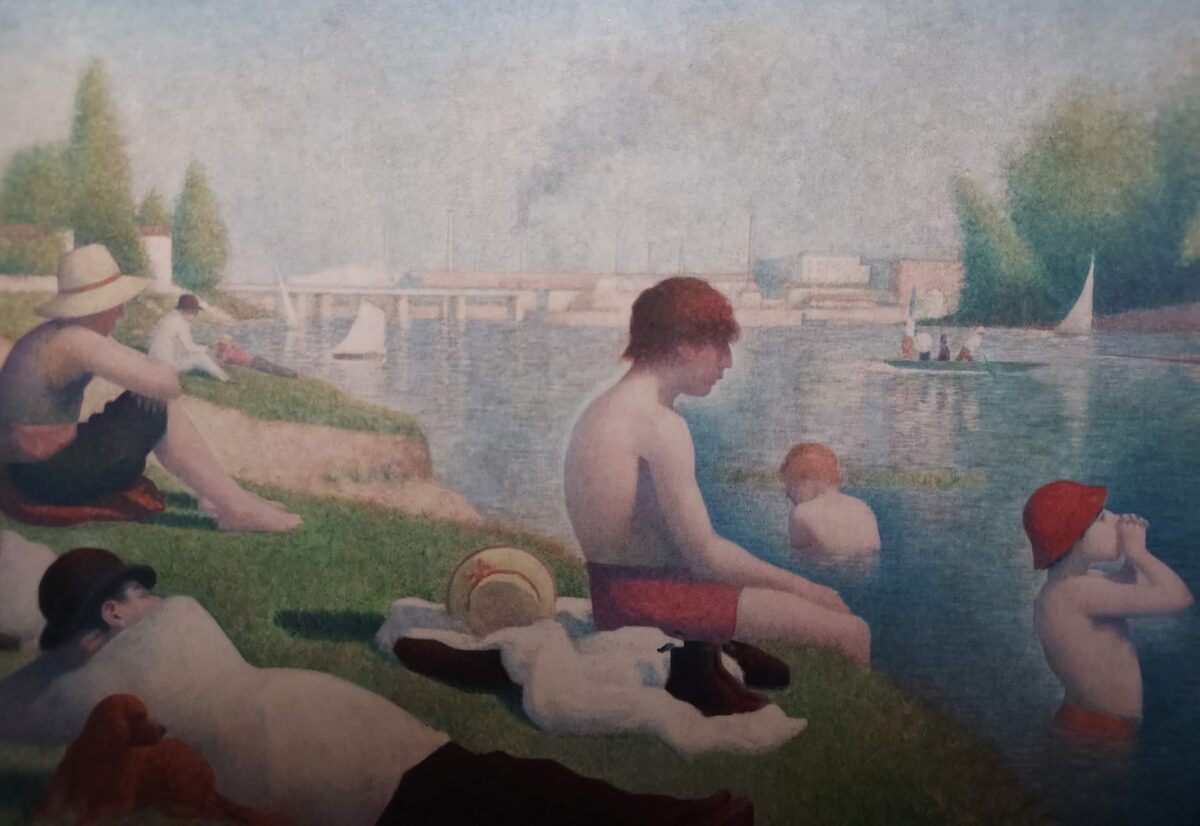
This exhibition, which features the collection of Helene Kroller-Muller, presents another account of this new movement, of which most people were unaware. I certainly had no idea. Within the movement, a group of painters identified as anarcho-communists. Remember, at the end of the 19th century, Marxists and Anarchists like Kropotkin and Bakunin were competing for the political leadership of the labour and progressive movement.
The article’s headline image, In the Time of Harmony by Paul Signac, illustrates their ideology. Their painting already sought to detach art from the empirical approach of the impressionists, who employed new brushwork techniques, oil paint in tubes, and outdoor work to capture fleeting impressions of people and nature. The pointillists:
Revolutionized art by pushing aside conventional modes of visual perception. Untethering the picture from its dependence on subject matter but increasing the emphasis on colour, light and geometry (…) it did no less than pave the way for modern painting
Catalogue, page 116
Artists who revolutionize conventional norms in the art world can also take a critical view of political and social reality. The Neo-Impressionists sought to create harmony within the picture itself rather than to reproduce a harmony derived from nature or other subject matter. In this picture Signac wants to project an image of a future utopia where workers were in harmony with nature.
Socialist Visions
It speaks to us today, as we recognize that a new social equality must go hand in hand with genuine harmony with Mother Nature. Here we see a barefooted worker stretching up to take a fig, a mother giving fruit to he child. Another is sowing the soil while a woman is picking white flowers. For the anarcho-communists, a free, fair world implied people should enjoy a life full of culture, leisure, and physical exercise. One man is engrossed in a book, another is painting, a couple are dancing, and two men are playing a form of bowls.
As Marx himself wrote in The German Ideology, a socialist future meant that people could ‘hunt in the morning, fish in the afternoon, rear cattle in the evening’. There is also this sense of a possible abundance. In an era of creeping fascism, it is important that we keep alive these visions of a better world
Signac and his fellow neo-impressionist and anarchist comrade, Henri-Edmond Cross, dreamed of :
‘making large-scale decorative paintings to hang in public places, to avoid producing easel-sized canvases that they knew would end up as luxury commodities’. (page 115 ibid)
Cross wrote to Signac saying that pictures from anarchists often depicted revolt or scenes of poignant misery, but it was important to imagine the ‘dreamed-of age of happiness, well-being, and general harmony. In fact, In Time of Harmony did end up in the town hall in the left wing, eastern suburb of Paris, in Montreuil
Workers’ dignity
Maximillien Luce (1858-1941) from Paris was closely linked to workers’ struggles from his base in the 14th arrondissement. Artisans and their guilds played a big role in these struggles – factories were not as common in Paris as they were in Manchester at the time. The cooperative ideal was very strong and artisans often worked within them. Supporting the anarchists also meant you risked repression, Luce was arrested in 1894. A fellow anarchist painter, Camille Pissarro who was put on a government watch list fled to Belgian. The movement was internationalist with the painters in France, Belgium and the Netherlands.
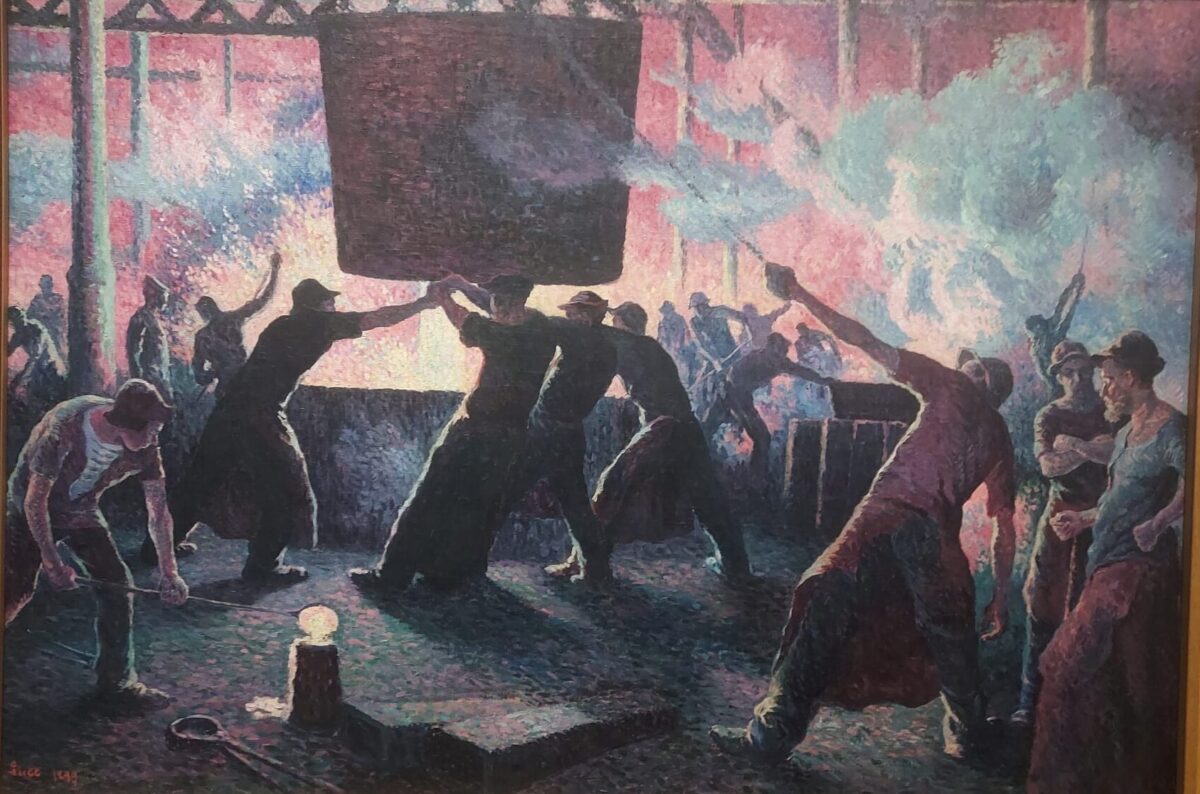
In this picture rather than focus on workers suffering he wanted to show their skills and cooperation. Again this artistic ideal of harmony was present in his mind. Luce was not particularly expressing the present day but a future where the workers would be healthy, safe and even have enough time for rest during their shift –see the two men on the left. You get a sense of human power and capacity. The fires of the foundry take your eyes to the centre of the workers’ activity. People sometimes remark about a certain beauty in some of big factories, a sense in which they are a culmination of human efforts over time.
Although bullshit jobs in front of a screen or ‘security’ have replaced many more worthwhile jobs socialists should always respect working people’s sense of pride in the work they do – for instance building a house or some useful infrastructure. We build on such labour and cooperation, we do not trash it.
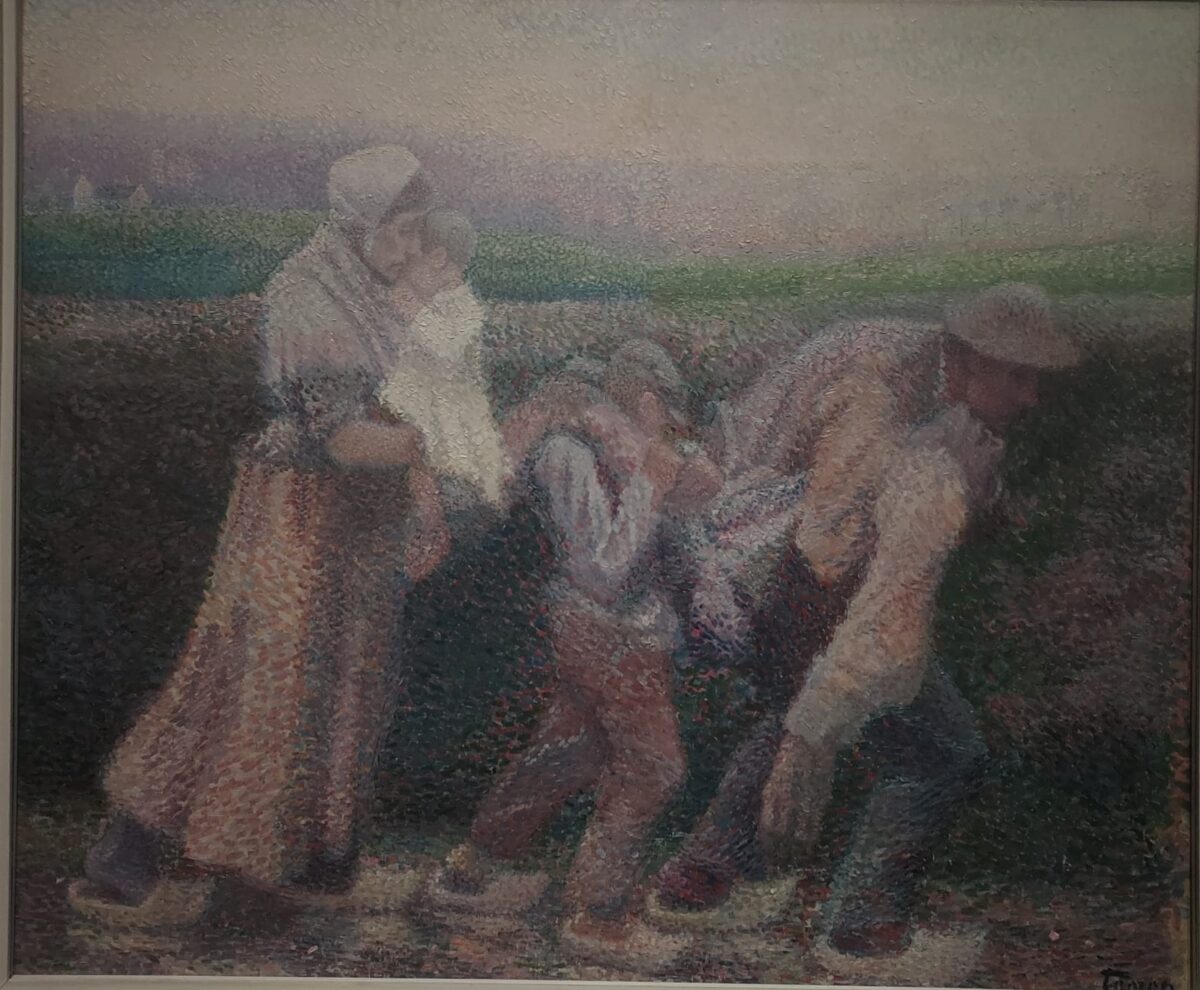
Jan Toorop lived near Charleroi, Belgium, and was aware of the violent strikes that occurred there. In this picture, we see a dead worker being carried away by his family. The father and son walk slowly forward, struggling to carry the dead, limp body. We see the implied association with Christian imagery – a dead Christ with his arm hanging down – you can see it in countless paintings of Christ’s deposition from the cross. Toorop depicts the child in white, underscoring the image’s poignancy. The painting is intimate and closed in on the family; we do not see the horizon towards which they are walking. An oppression that was systematic to capitalism is brought close up.
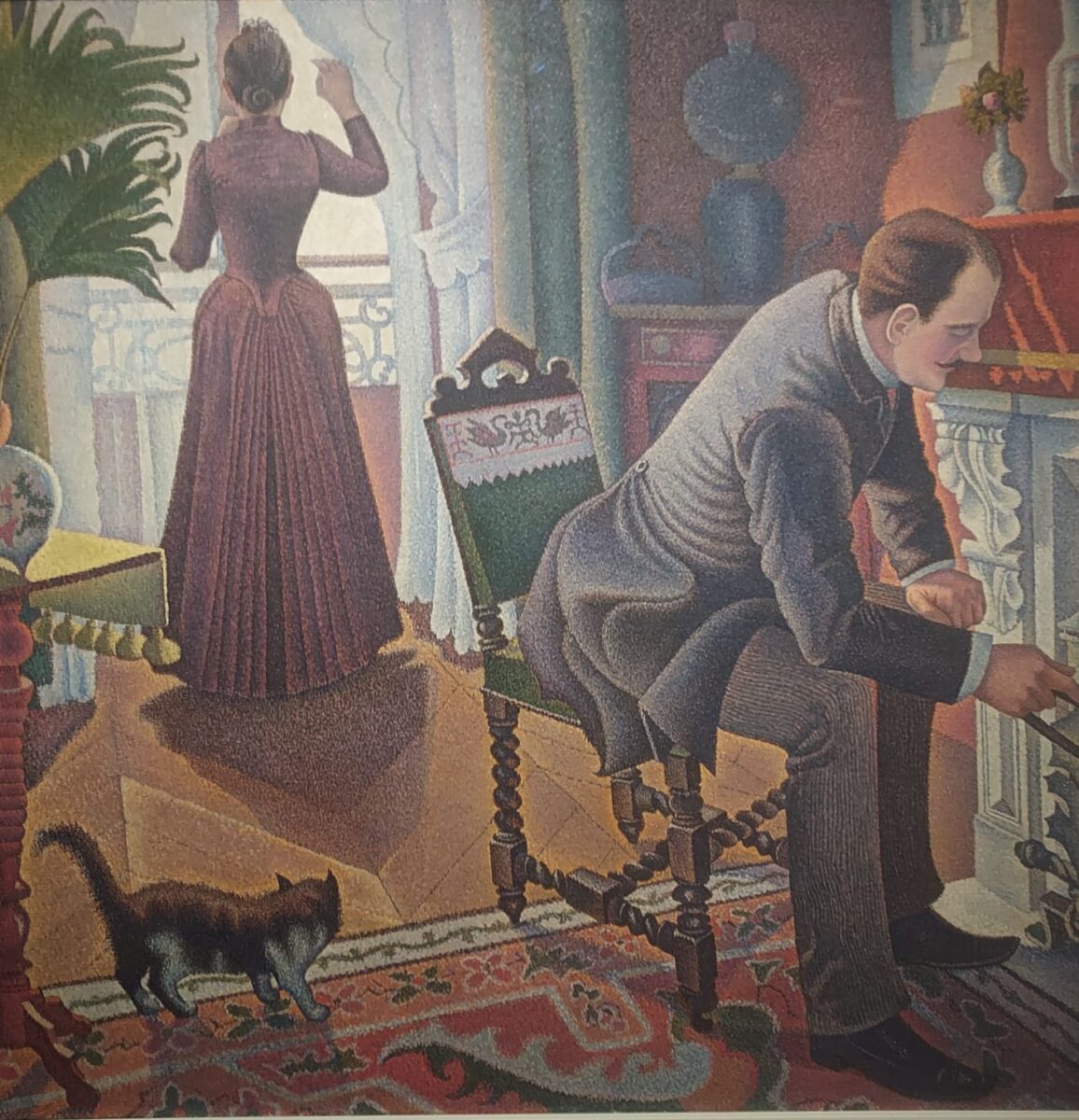
Another set of pictures in the show portrays what could be called the alienated life of middle-class or bourgeois households. This was something close to anarchists’ hearts; they did not just see exploitation in the factory, but all of life and society was stifling and oppressive. In this picture byPaul Signac, there is a stillness and coldness to the scene. Signac’s friend described the Sunday picture as the ‘dreary boredom of a couple drawing out their bad-tempered nonchalance in the richness of an overheated living room’ (catalogue p.158).
The couple has their backs to each other. A bristling cat between them seems to suggest a simmering tension. The picture meticulously records the objects of a middle-class family of the time. Of course, there were some contradictions behind this perspective. Signac lived in a pretty bourgeois, well-off household himself and was conventionally married.
There are some other interesting pictures to see it the exhibition. The landscapes I thought were more stimulating than the portraits since their minimalism and composition capture how the neo-impressionists were a bridge to a more abstract modern art. With all these pictures you need to stand a certain distance away to get the full effect. Looking at a number of the landscapes you really do experience a sense of calm and harmony that they were seeking. The show is well worth a visit and continues to February 8th
Art Book Review Books Capitalism China Climate Emergency Conservative Government Conservative Party COVID-19 EcoSocialism Elections Europe Fascism Film Film Review France Gaza History Imperialism Israel Italy Keir Starmer Labour Party Marxism Marxist Theory Palestine pandemic Protest Russia Solidarity Statement Trade Unionism Ukraine United States of America War