

I am getting old now but not as old as my broken, fucked up vagina that is so connected to my soul
text from painting, The Last of My Kind 2019
Emin’s body, her vagina, is at the centre of the imagery in the show; it is the heart of her art, her existence. You see it in many of the works. The show is about sex, love, pain, illness, disability, confronting death, grappling with guilt and self-worth, and coming out the other side – her second life. Her exhibition is called that because today she has found some stability, a degree of peace.
Emin accepts that her excesses gave meaning to her life, but she reached a point where she knew if she went on, she would die. In recent interviews, she says she has come through and is in a better place, and you can see this inner strength, particularly in the final rooms.
Like Frida Kahlo, one of her heroines, she makes her own body her predominant subject. Since sexism and patriarchy are about men controlling and sometimes mutilating women’s bodies, this means her art becomes a political and feminist statement. Tracey Emin knows she is the opposite of the constructed female model of fashion or advertising.
Deborah Treisman from the New Yorker (Tate Catalogue p28) said: ‘People like women in the spotlight either to be perfect, or to be embarrassed not to be perfect – people did not like her lack of embarrassment about her life.’
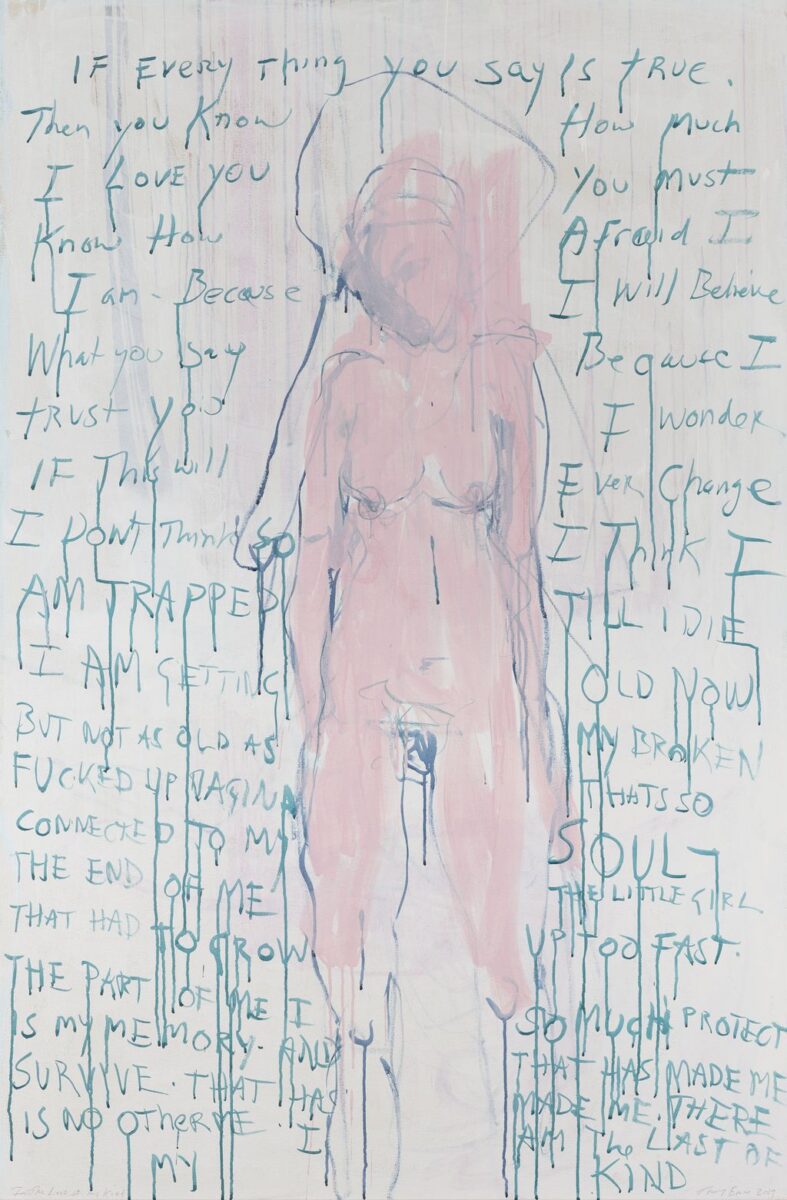
Emin paints her rejection of that manufactured model. Gisele Pelicot, who confronted her husband, who organised the rape of her body, said shame needs to change sides.
Emin talked about an earlier show saying: “this whole show is about releasing myself from shame. I’ve killed my shame. I’ve hung it on the walls’ (catalogue p25). Liberation means rejecting the male definition and imposition of shame.
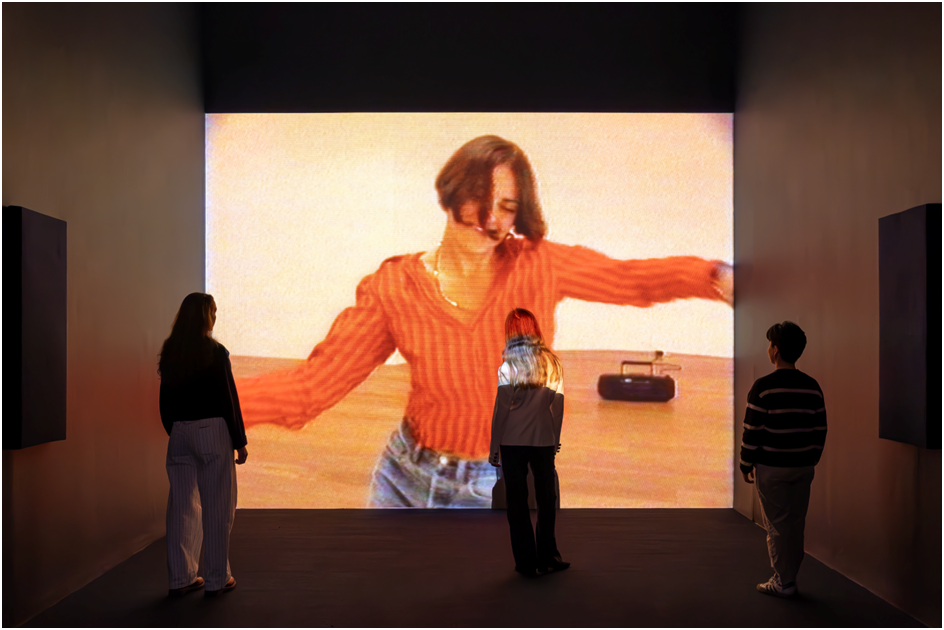
Emin works in many forms – texts, videos, installations, sculptures, tapestries, photos and paintings. At the beginning of the exhibiton there is a video entitled Why I Never Became A Dancer 1995, in which the artist recounts traumatic events from her teenage years in Margate. It takes up the whole wall with Emin dancing on a disco floor but accompanied by her commentary.
She loved going to this disco while a young teenager, but one day she was surrounded by a group of men – some of whom she had slept with – who started shouting slag, slag at her. This traumatises her; she runs off, and she does not come back.
Sex, was something simple. You’d go to a pub, walk home, have fish and chips then sex… there were no morals, or rules or judgements. I just did what I wanted to do.
op cit p25
The video ends with her dancing joyfully and defiantly: ‘I left Margate and left those boys. Shane, Eddie, Tony, Doug, Richard. This one is for you.’
It was noticeable how many women, maybe 70% plus, were visiting the exhibition. I was surprised by how many young women were there, too. My guess is many were not born when Emin burst onto the art scene and the mass media with her My Bed installation at the Turner Prize exhibition.
At the moment, the current show is busy indeed. It shows that, despite the media scoffing at the so-called limits of her ‘confessional’ art and at her supposedly technical weakness, Emin has expressed what many young women have experienced. Maybe younger people today feel less embarrassed and hung up about sex and gender than previous generations. Emin’s artistic expression of her personal experience makes her art more, not less, universal
This is her biggest-ever retrospective, and it reveals the journey she has been on through pain, suffering, and heartbreak towards tranquility and renewed energy to make art and ensure more artists can come through. She is using her relative wealth to provide housing and studio space in Margate for aspiring artists.
Emin has moved on from a time when she voted for Boris Johnson for London Mayor and for Cameron because she thought they supported the arts. In a recent Guardian interview, she calls on people to oppose Reform. She is also investing in a training kitchen and supporting other community initiatives in her hometown.
Emin was raped at 13 and has had two abortions, one of which was quite late and traumatic. Another video in the show goes through that experience. The Last of the Gold, a tapestry made from a blanket (her father ran a hotel for a while), takes up the A-Z issues around abortion and offers some guidance and advice. She criticises the male-dominated medical profession.
My Bed (1998) sits at the centre of the exhibition. At the time the tabloid press did its usual moral panic about ‘anybody being able to do this’ and ‘is this art?’. It was particularly venomous because it was a young woman artist. As Emin says they never made the same fuss about Jeff Koons’ soft porn work with Ilona Staller, because she fitted the male definition of feminity.
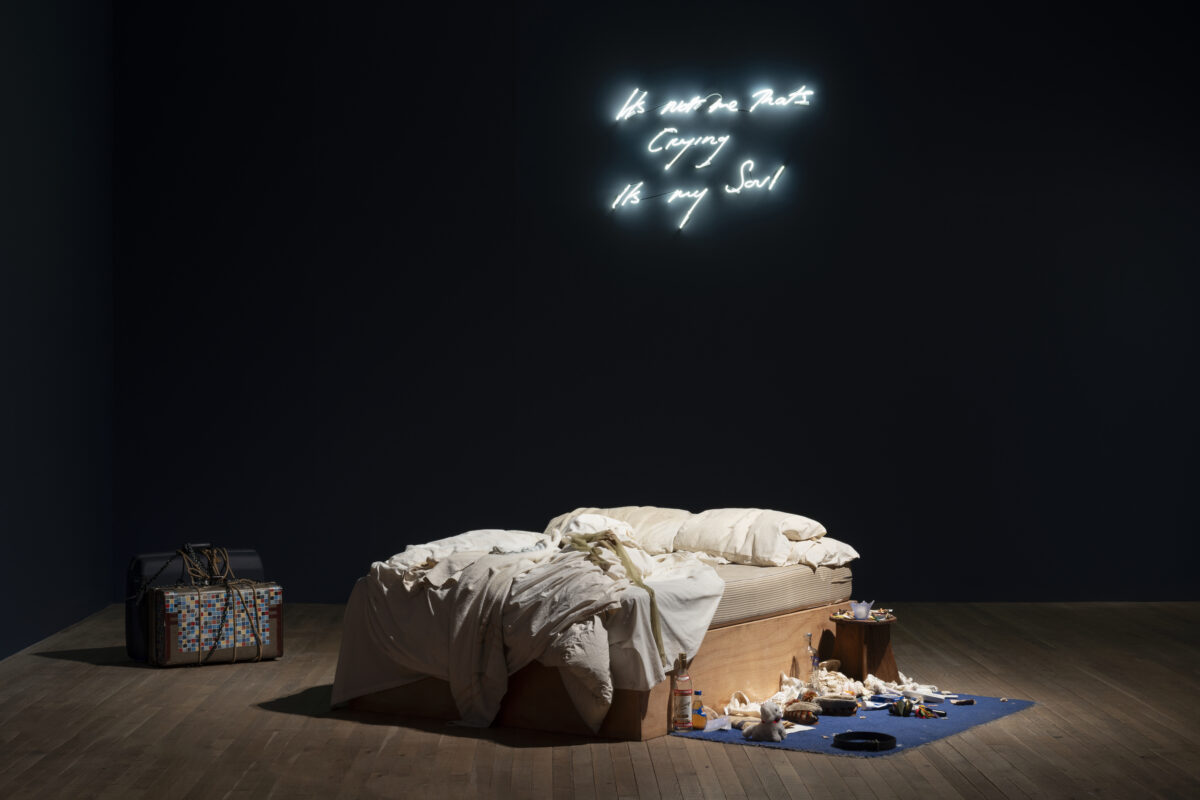
The double bed was left in this state after she had stayed in it for several days while suffering from depression. Empty vodka bottles, cigarette ends (she had a 50 a day habit), stained sheets, dirty underwear and tights, condoms, Polaroids and a fluffy white toy. Hand on heart a lot of us have perhaps been there, so like all great art it resonates with our experience.
Back in the 90s, people used to say it was confessional art. It wasn’t. I wasn’t confessing anything at all to anybody. Nothing to confess. I was just trying to unravel everything and work out where it all came from, and why this was this, and why that was that. I wasn’t trying to shock anybody , either.
p51, op cit
On the one hand, I think you spend less time looking at this installation than at other works in the show that are more inspiring or ‘beautiful’. It is a conceptual piece and once you ‘get it’ you do not need your eye to dwell on it. On the other hand, the bed represents a continuity, a thread that runs through all the other themes she tackles in her art.
You mostly have sex on a bed, and you experience illness and pain on a bed. You have an abortion on a bed. You bleed, and nearly all of us die in a bed. Disabled people often spend more time in bed. In this show, My Bed marks the transition through which she comes into her Second Life. In fact, in recent interviews, she remarks how her bedding is absolutely impeccable and tidy these days!
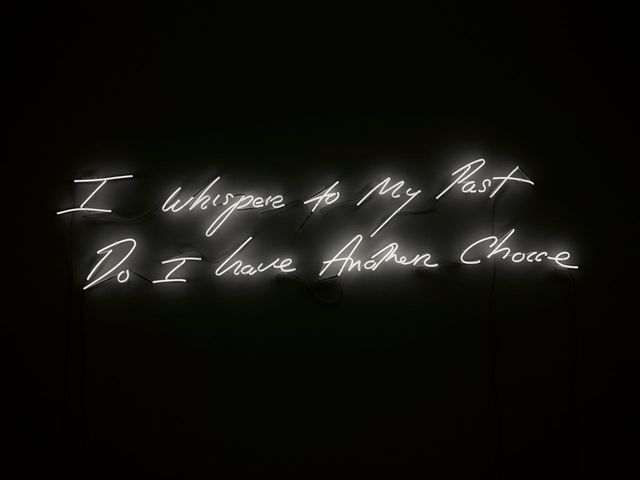
People may not realise how important text is in her work. Words fill her tapestries, comprise essays of pages and pages, become neon signs, and are integral parts of her paintings. If you take the time to read the essay forms, you find she writes vividly and honestly about her life.
One difficulty in a crowded exhibition and reading from a wall is that you cannot read them properly, which is an argument for buying the catalogue where you can read them easily.
Tracey Emin comes from a family with a Turkish Cypriot father and a Roma mother. She recalls the racist abuse she received when younger. Her father went bankrupt and left, and she was brought up in a relatively poor single-parent family. She left school at fourteen. Fortunately, at the time, there was more opportunity to get into art college with less formal qualifications, and she ended up with a postgraduate art qualification. Not many artists make it from this sort of background.
In 2020, Emin was diagnosed with bladder cancer. Doctors removed her bladder, womb, urethra, some intestines, lymphatic system, and half her vagina. She nearly died, and several pictures reflect her closeness to death.
A blood redness dominates the palette in this show. An entire corridor is given over to photos she took of her illness. Some women recently have been on TV/social media campaigning to lift the stigma from women having to have stoma bags (when you have an artificial excretion/urinal system installed). The artist is doing a similar thing here very effectively.
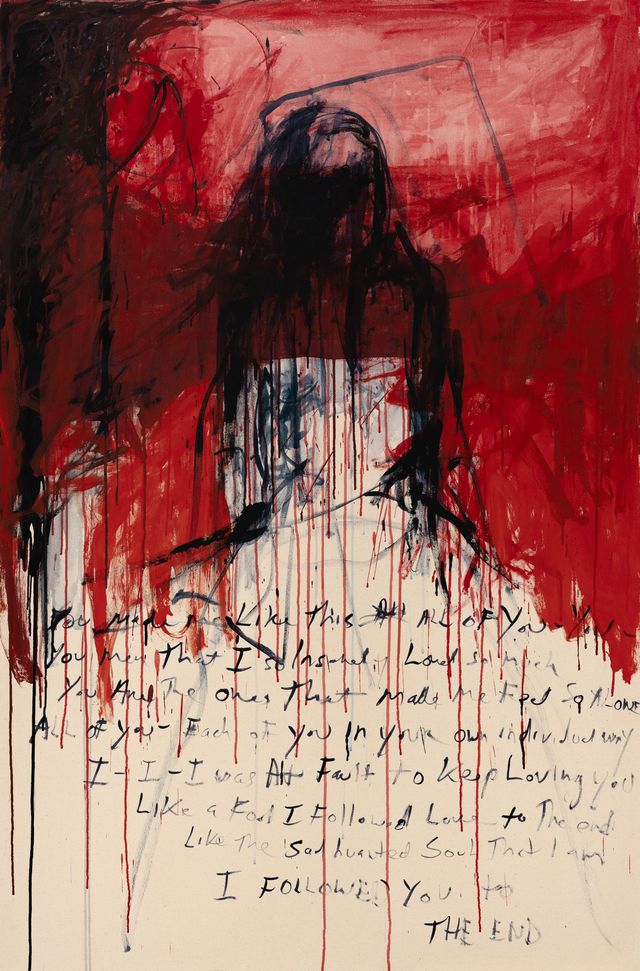
For me, the final rooms with the large paintings were the highlights of the show, partly because I was familiar with some of the earlier works. You could describe the paintings as abstract and figurative. Bold strokes of red, pink, and black set against big white backgrounds.
These are all the more poignant because we know her state of health means this work is very gruelling for her now. It is like seeing the expressionist portraits of women by Egon Schiele – which Emin loves – but shorn of a broader range of colour and of naturalistic detail.
There is a very moving picture of her carrying her mother’s ashes in a box. Her figure is enveloped in a billowing dark shadow of sorrow. In an previous room you can see a video of her talking with her mum.
Emin nearly died and she has made her own death mask here on display. The picture which closes the exhibition is of her on the bed with the figure of death, all black, at the end of the bed (another bed!) In the background there is an altar. Running down the bed are byzantine patterns relating to her ethnic background. It as if towards death she comes back to her beginnings.
There is a magnificent large sculpture called I Want Love where she stands proud and defiant with her hand on her vagina… she seems to be saying this is me, this is my experience, I am a confident, strong and without shame. You feel happy for her and for anybody who has come through to the other side, to a second life.
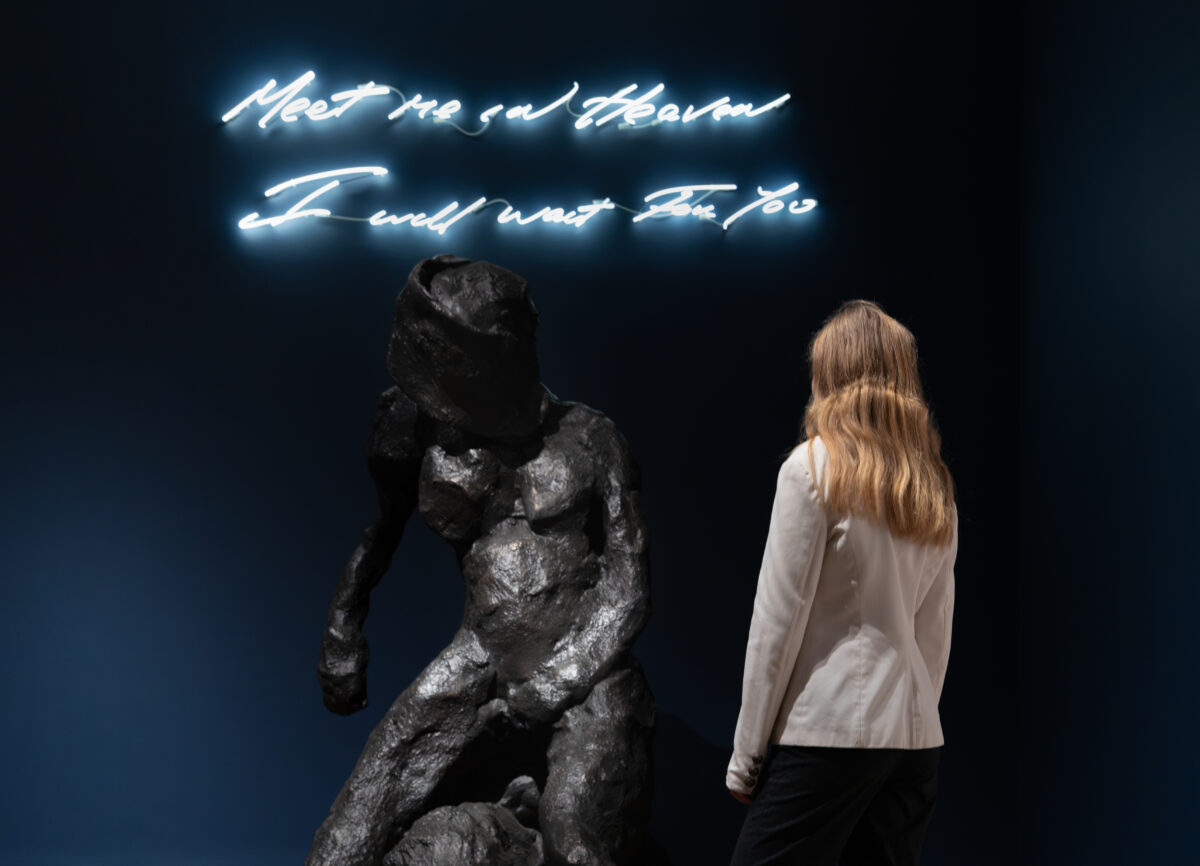
That’s what binds me, that’s what keeps me, that’s the glue of me, knowing that things hurt, and being able to feel that. I think the worst thing in the world is to be numb.
p 109 op cit
No matter how sad I am. I will never be as sad as before
All pictures from Tate press photos
Art Book Review Books Capitalism China Climate Emergency Conservative Government Conservative Party COVID-19 EcoSocialism Elections Europe Fascism Film Film Review France Gaza History Imperialism Israel Italy Keir Starmer Labour Party Marxism Marxist Theory Palestine pandemic Protest Russia Solidarity Statement Trade Unionism Ukraine United States of America War
This is a great review, thanks. It’s unusual to read about Tracey Emin where the work comes first.